





Map Snapshot


347 Records
Status
Description
Where To Find
Relationships
Citations
No citations linked for this taxon yet.
Source: Wikipedia
 | This article includes a list of general references, but it lacks sufficient corresponding inline citations. (January 2019) |
| Alnus serrulata | |
|---|---|

| |
Scientific classification 
| |
| Kingdom: | Plantae |
| Clade: | Tracheophytes |
| Clade: | Angiosperms |
| Clade: | Eudicots |
| Clade: | Rosids |
| Order: | Fagales |
| Family: | Betulaceae |
| Genus: | Alnus |
| Subgenus: | Alnus subg. Alnus |
| Species: | A. serrulata
|
| Binomial name | |
| Alnus serrulata | |

| |
| Natural range | |
| Synonyms[2][3] | |
|
List
| |

Alnus serrulata, the hazel alder or smooth alder, is a thicket-forming shrub in the family Betulaceae. It is native to eastern North America and can be found from western Nova Scotia and southern New Brunswick south to Florida and Texas.
Description
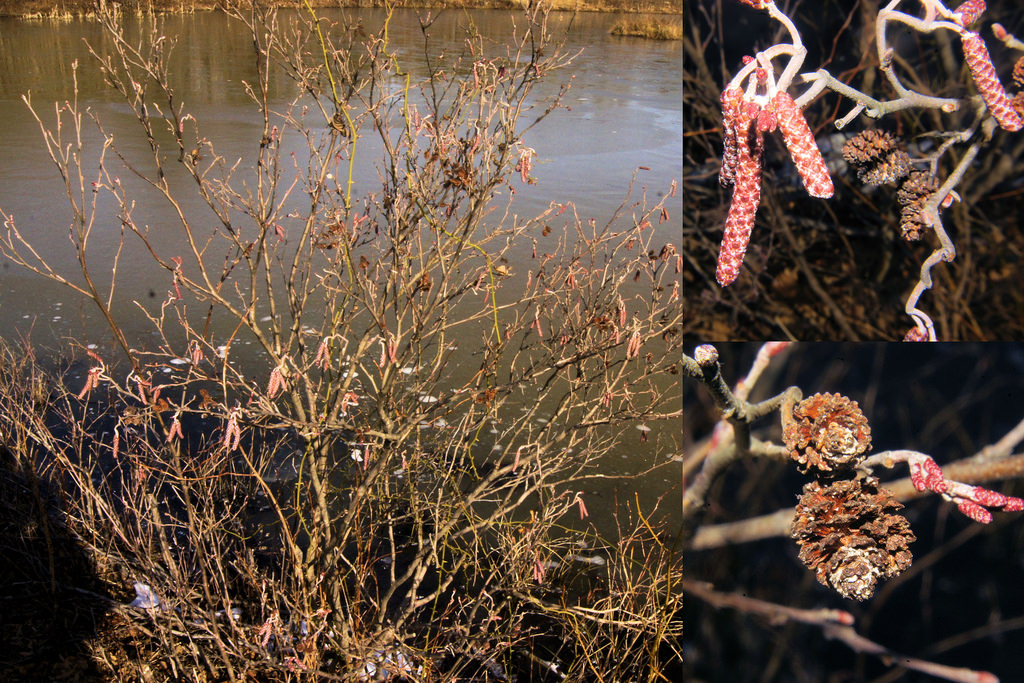
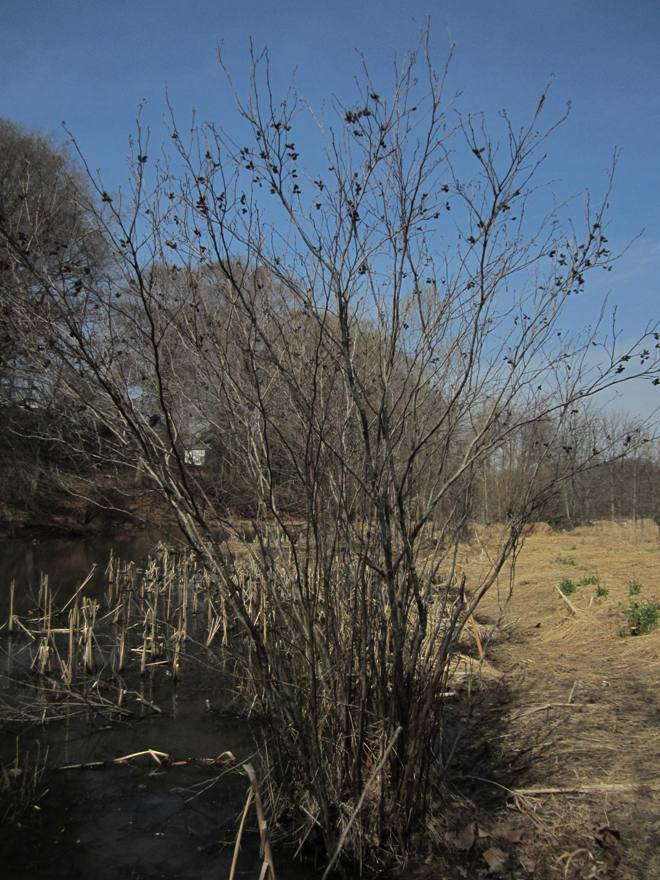
[edit]Alnus serrulata is a large shrub or small tree that commonly grows up to 8–12 feet (2.4–3.7 m) high,[4] exceptionally 30 ft (9.1 m)[5] and 15 centimetres (5.9 in) in diameter.[citation needed] The scientific name originates from alnus which is an old name for alder; serrulata points to the finely-toothed leaf margins which it possesses. It takes about 10 years to mature. The plant prefers moist soil near streams, pond margins, and riversides[6] and can be rooted under the water line.[7] It can also be found growing on hills.[4] It usually has multiple stems from its base and reddish-green flowers. The broad, flat, dark green leaves are about 2 to 4 inches long.[8]
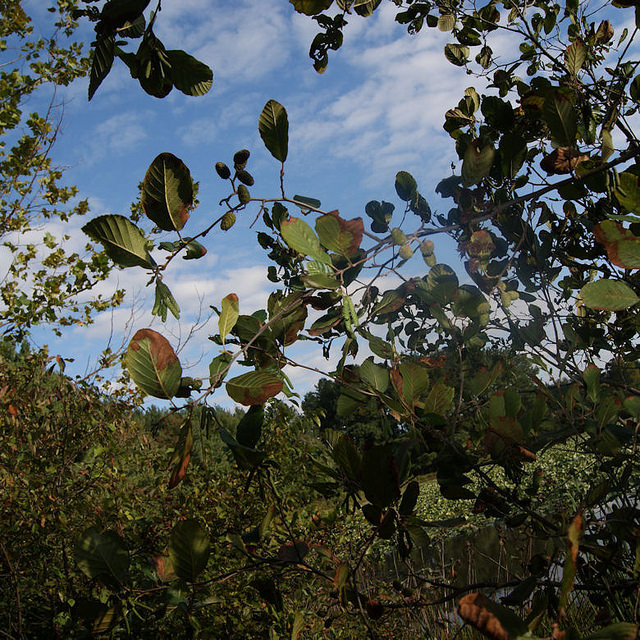
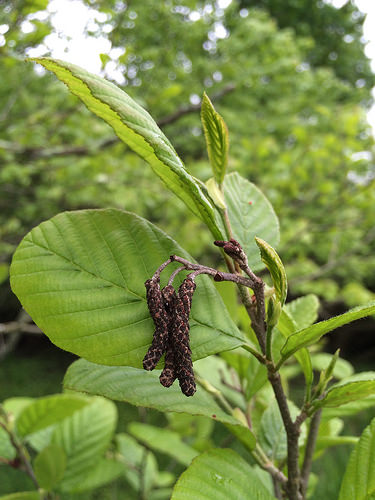
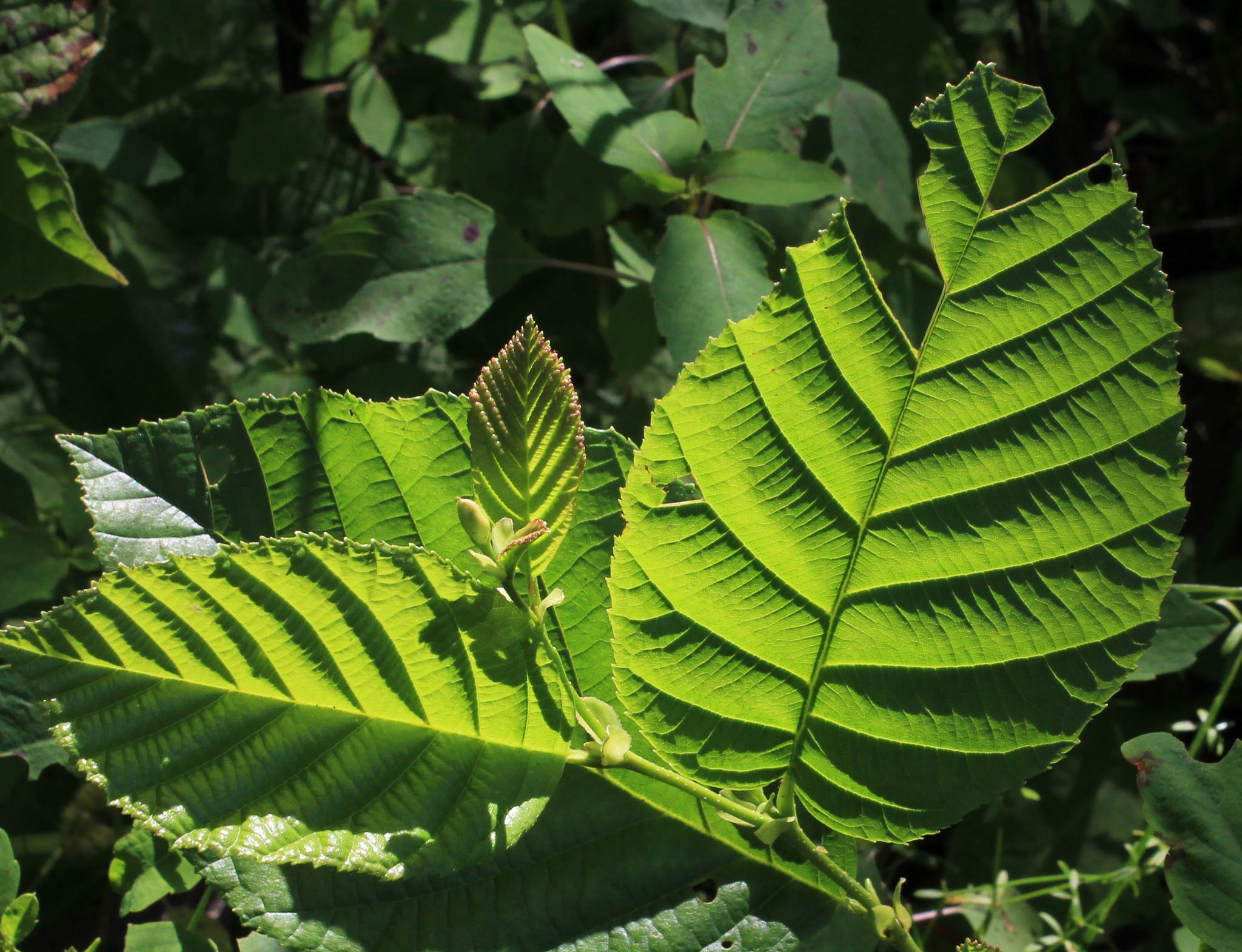
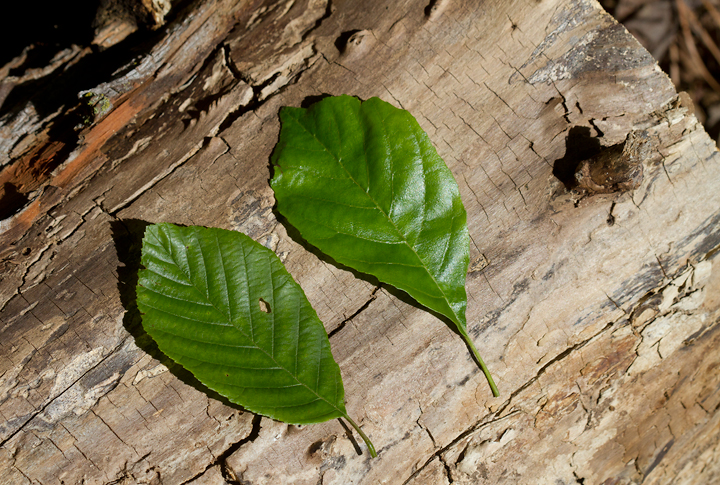
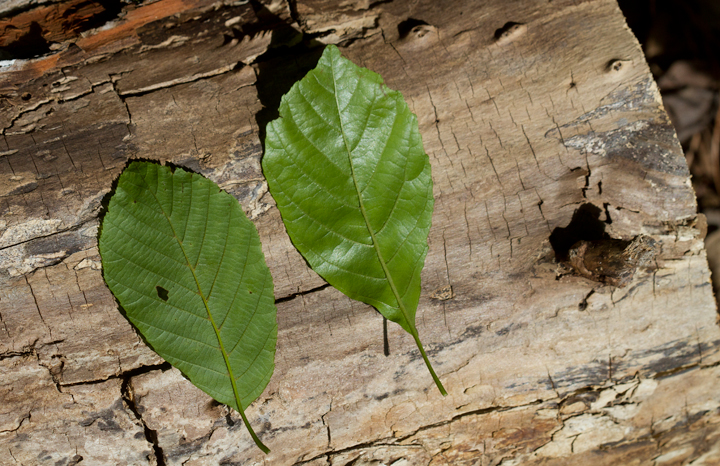
Leaf: The simple, round leaves are obovate, 3 to 5 in (7.6 to 12.7 cm) long,[9] 1.2 to 2.8 in wide,[citation needed] obtuse, wider at middle, and V-shaped base. Veins are pinnate and conspicuous. Leaves have a smooth texture above and hairy texture below. The upper side of the leaves are dark green and the undersides are pale green.
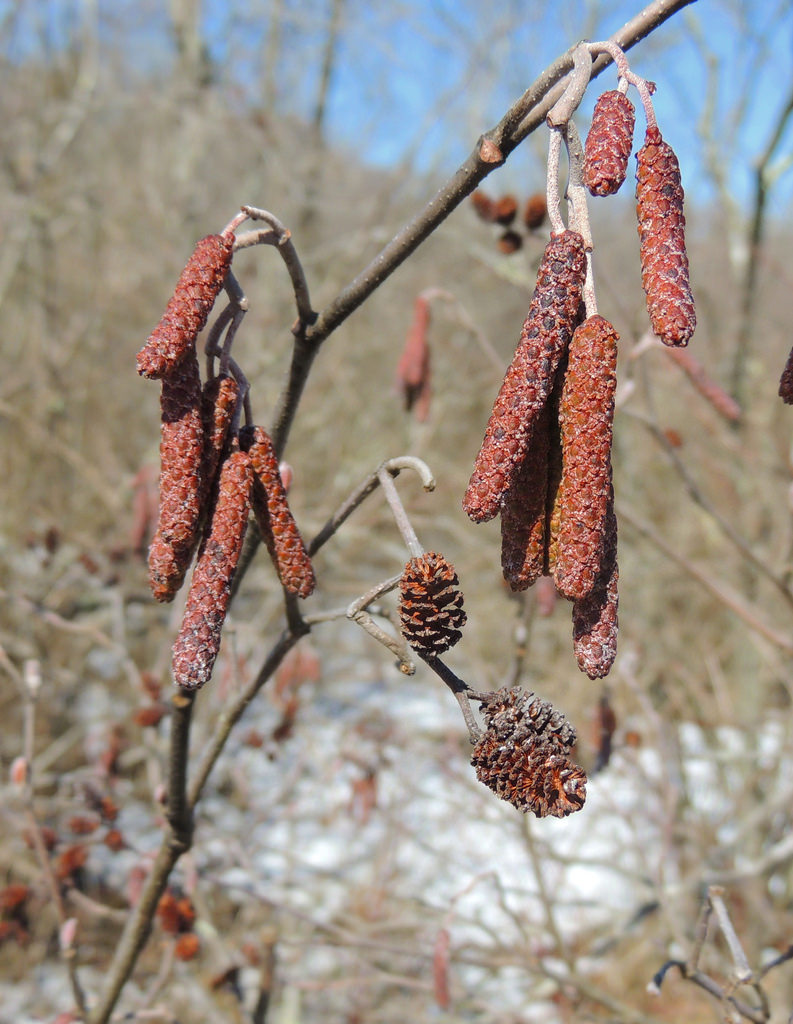
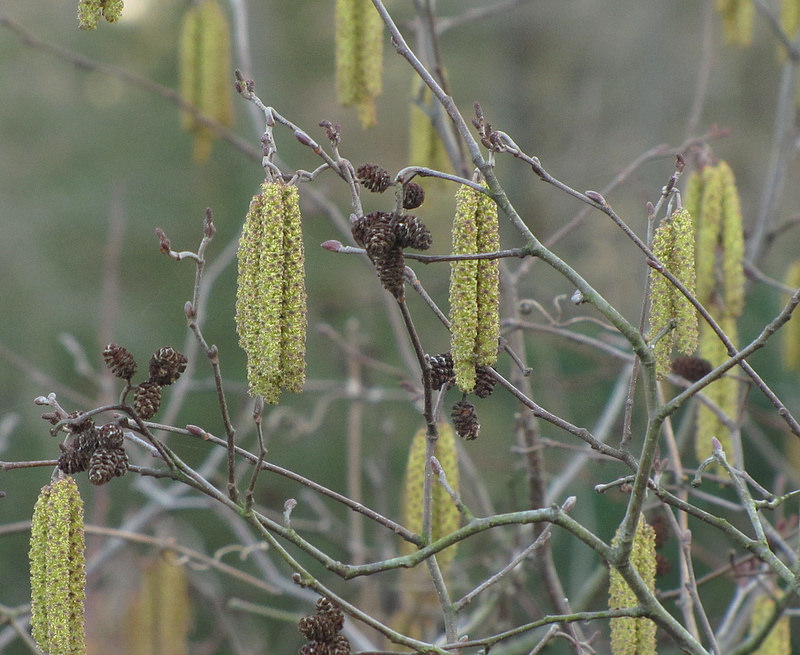
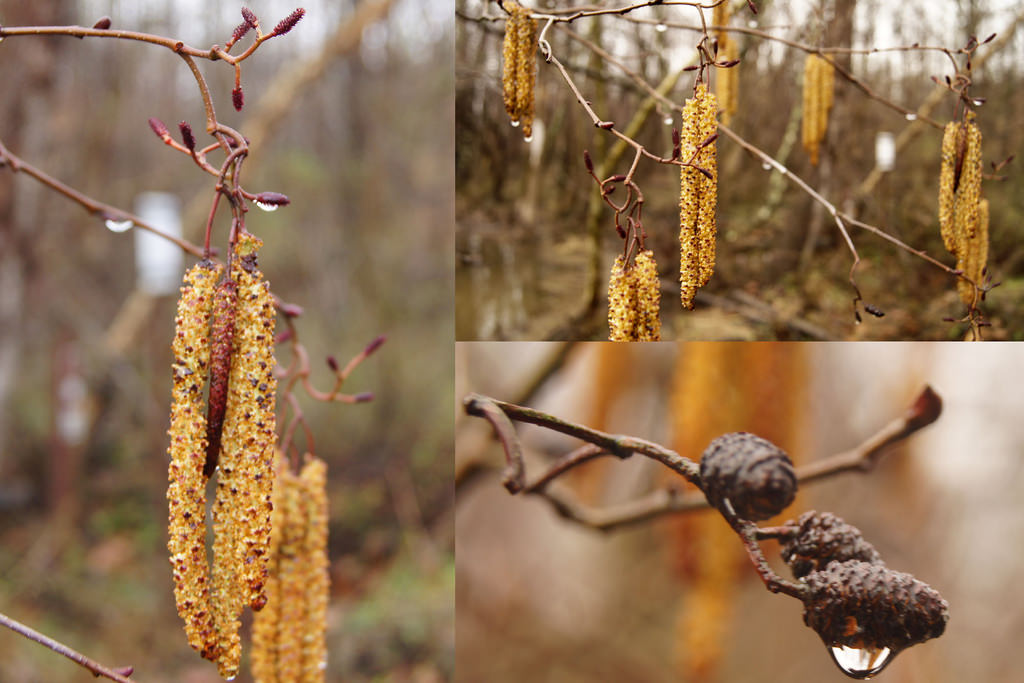
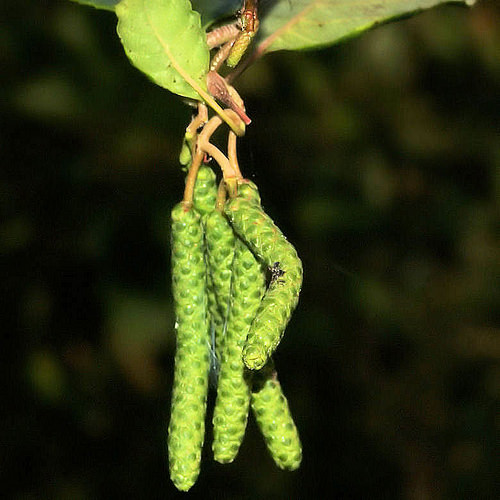
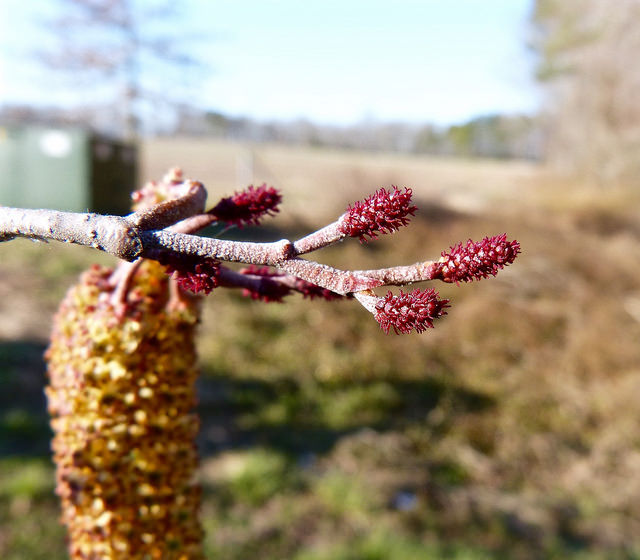
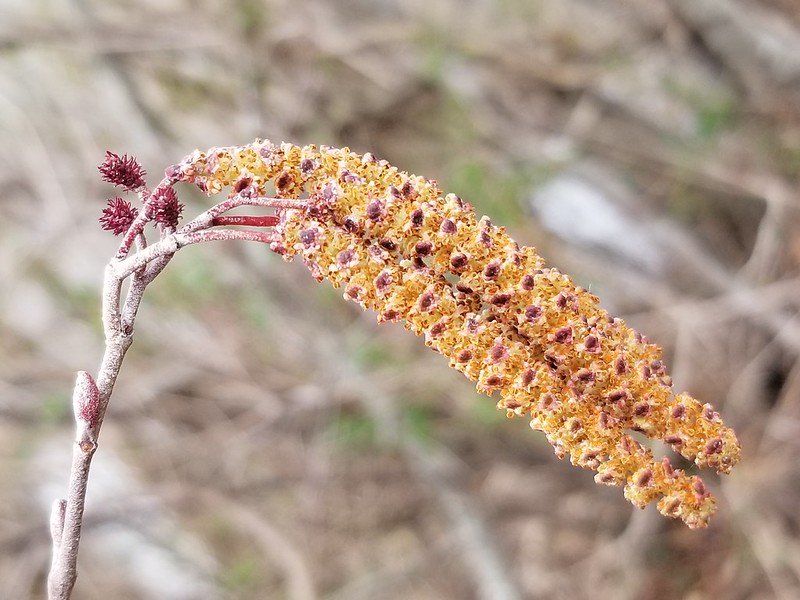
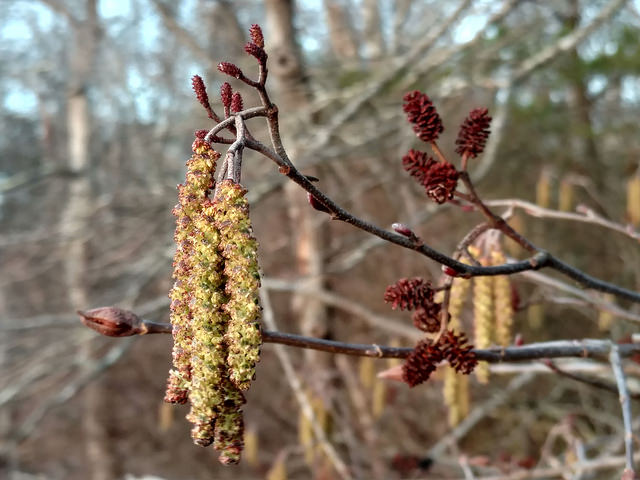
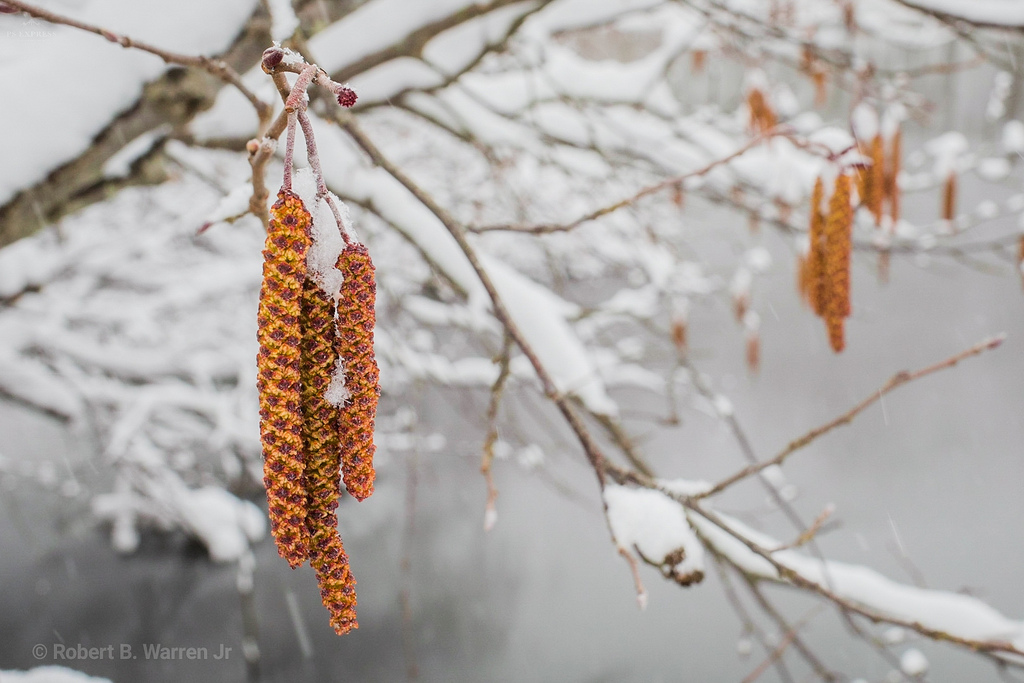
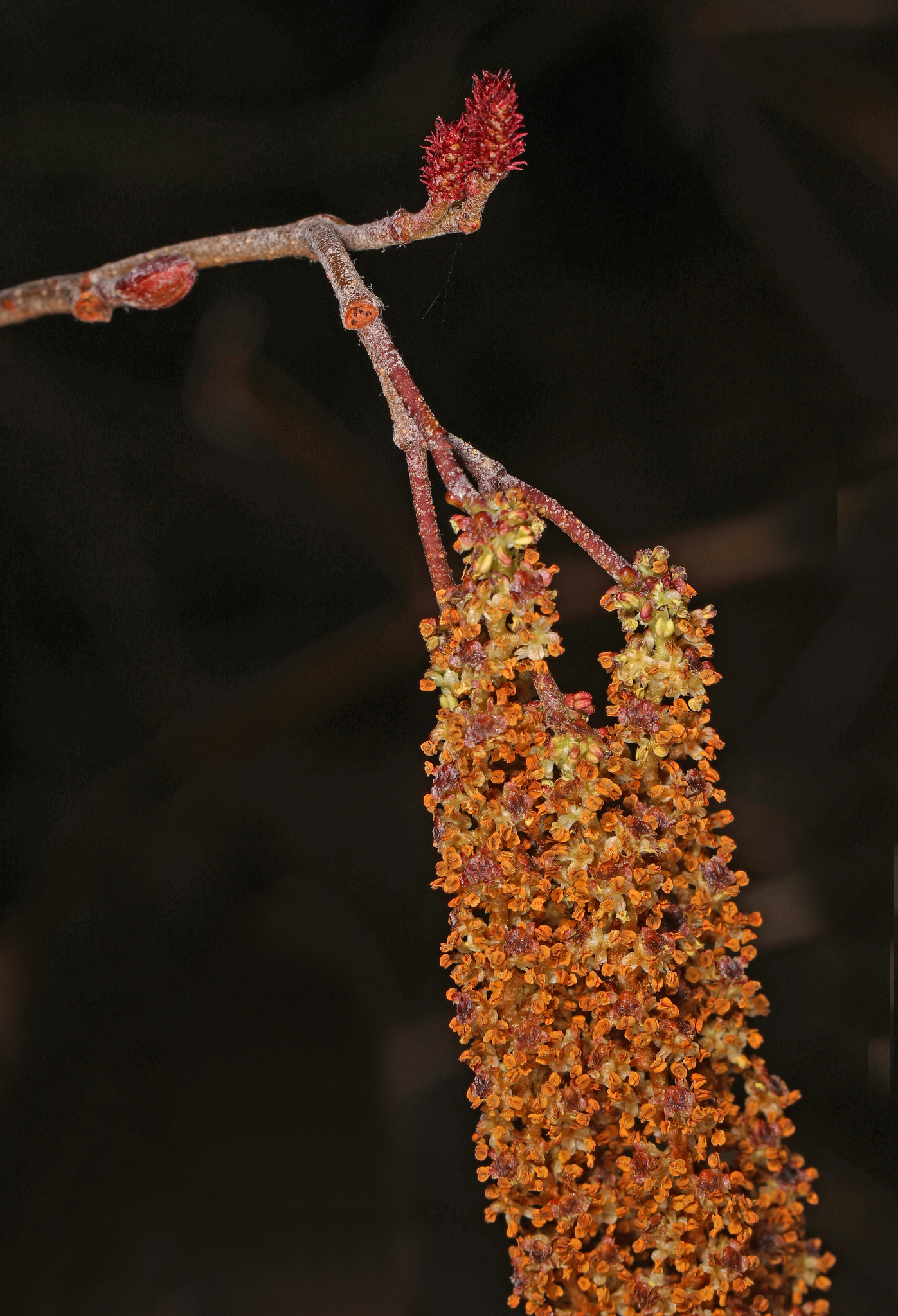
Flower: The flowers are monoecious, meaning that both sexes are found on a single plant. Male (Staminate) catkins are 1.6-2.4 in long; female (Pistillate) catkins are 1/2 in long.[citation needed] Reddish-green flowers open in March to April.
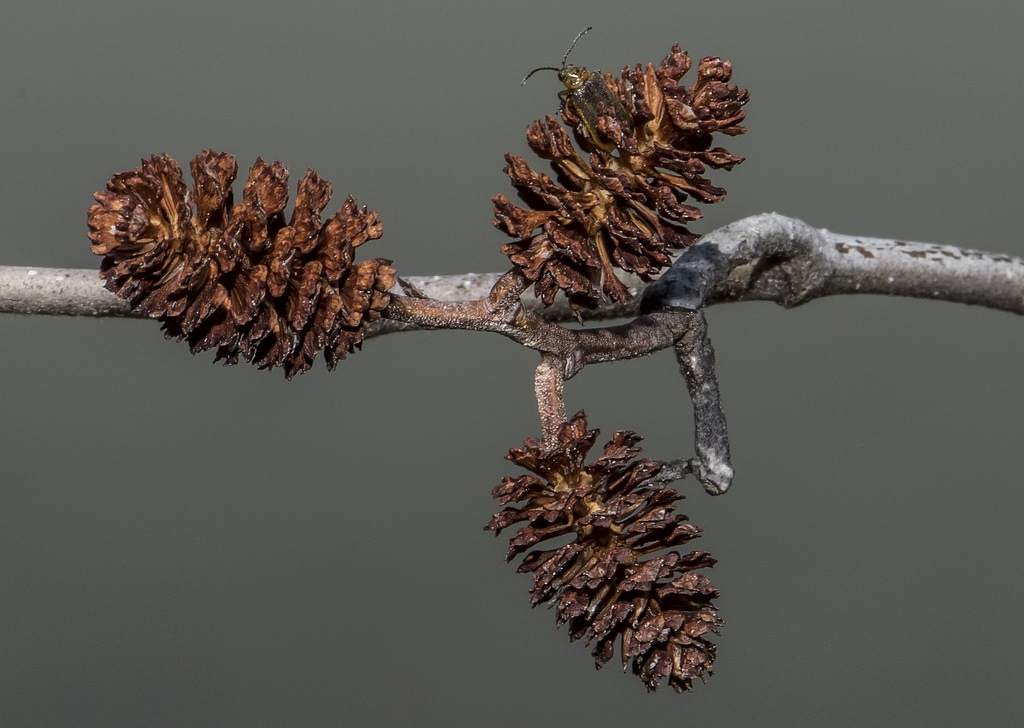
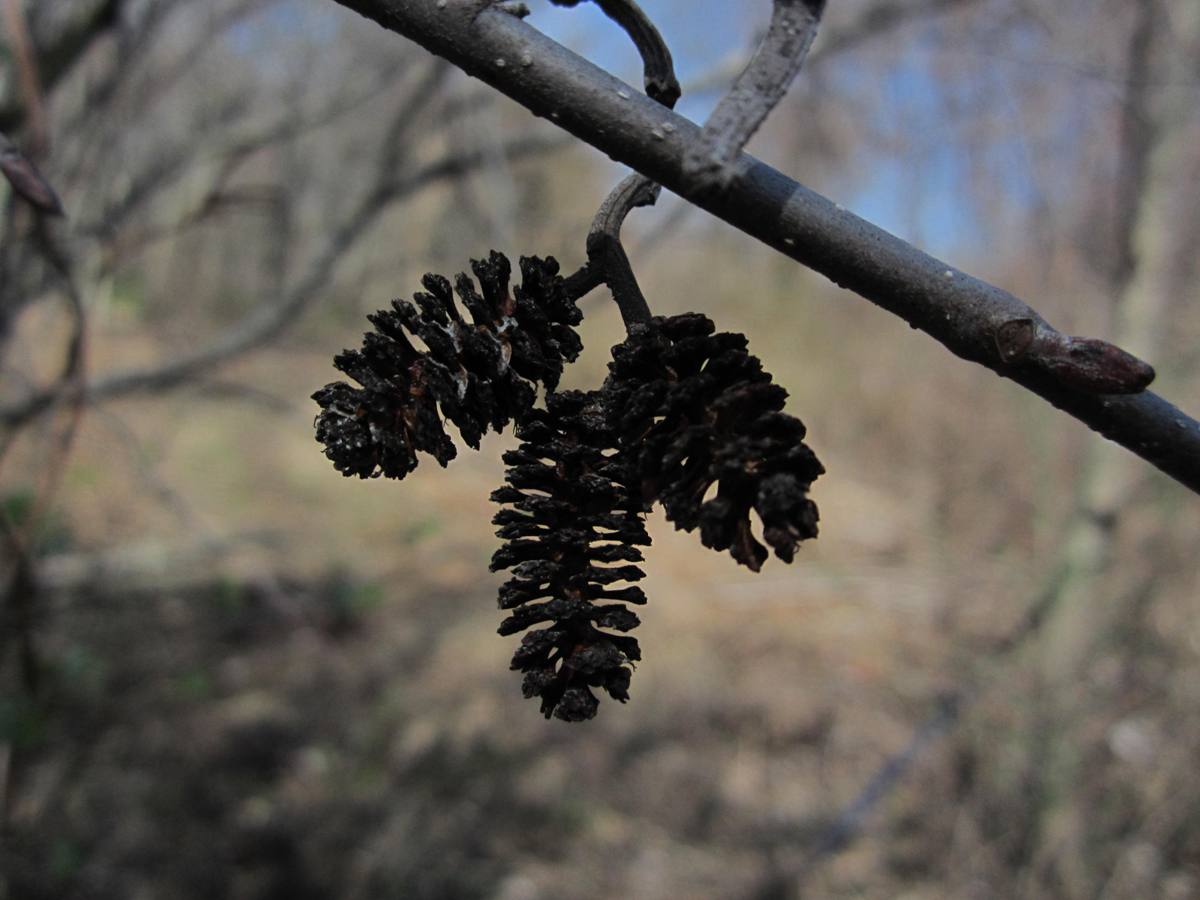
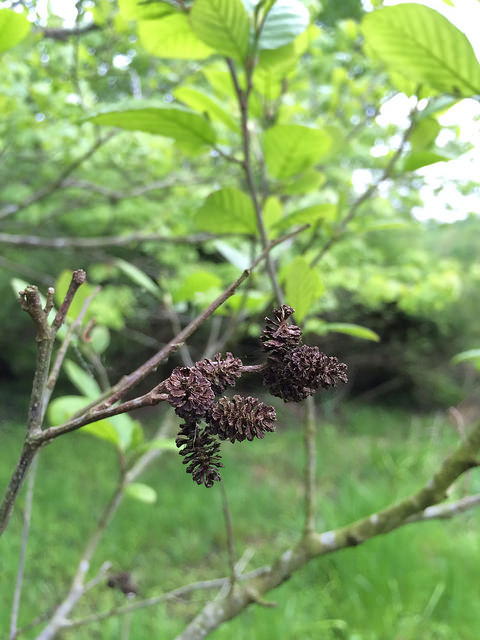
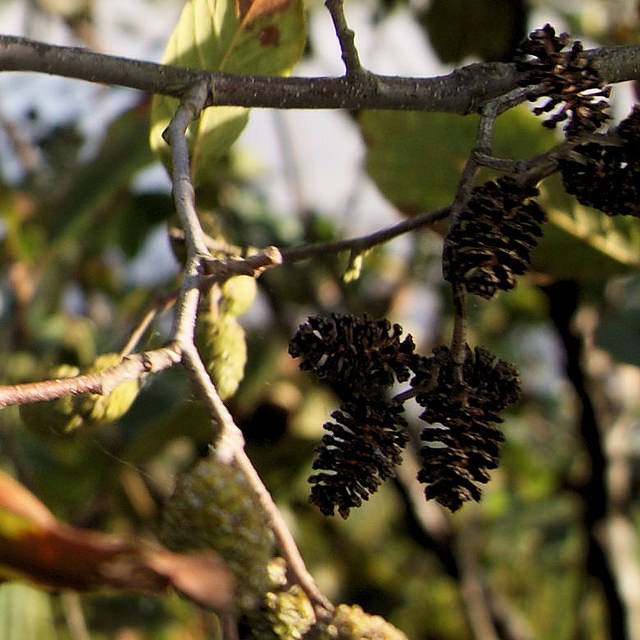
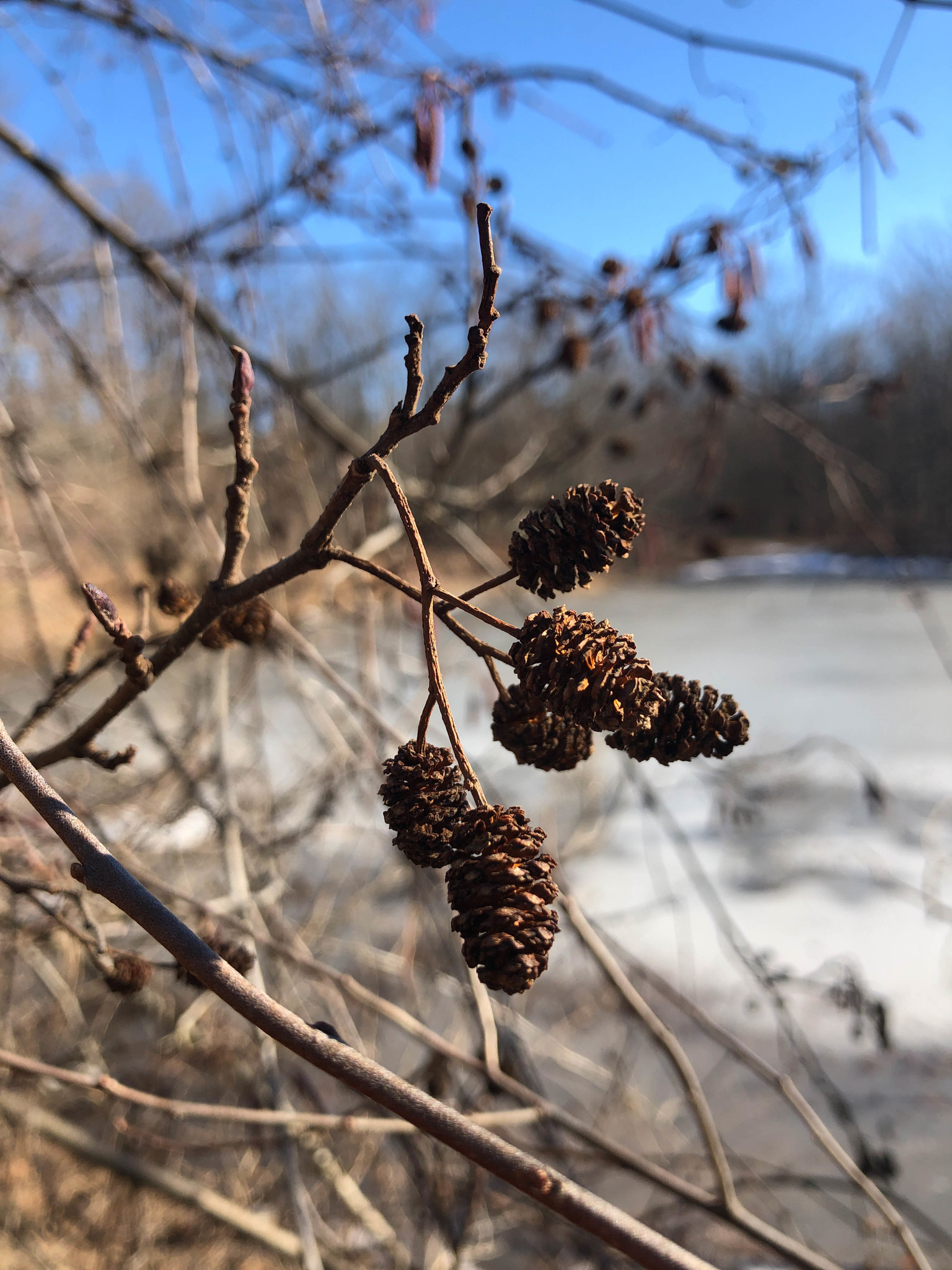
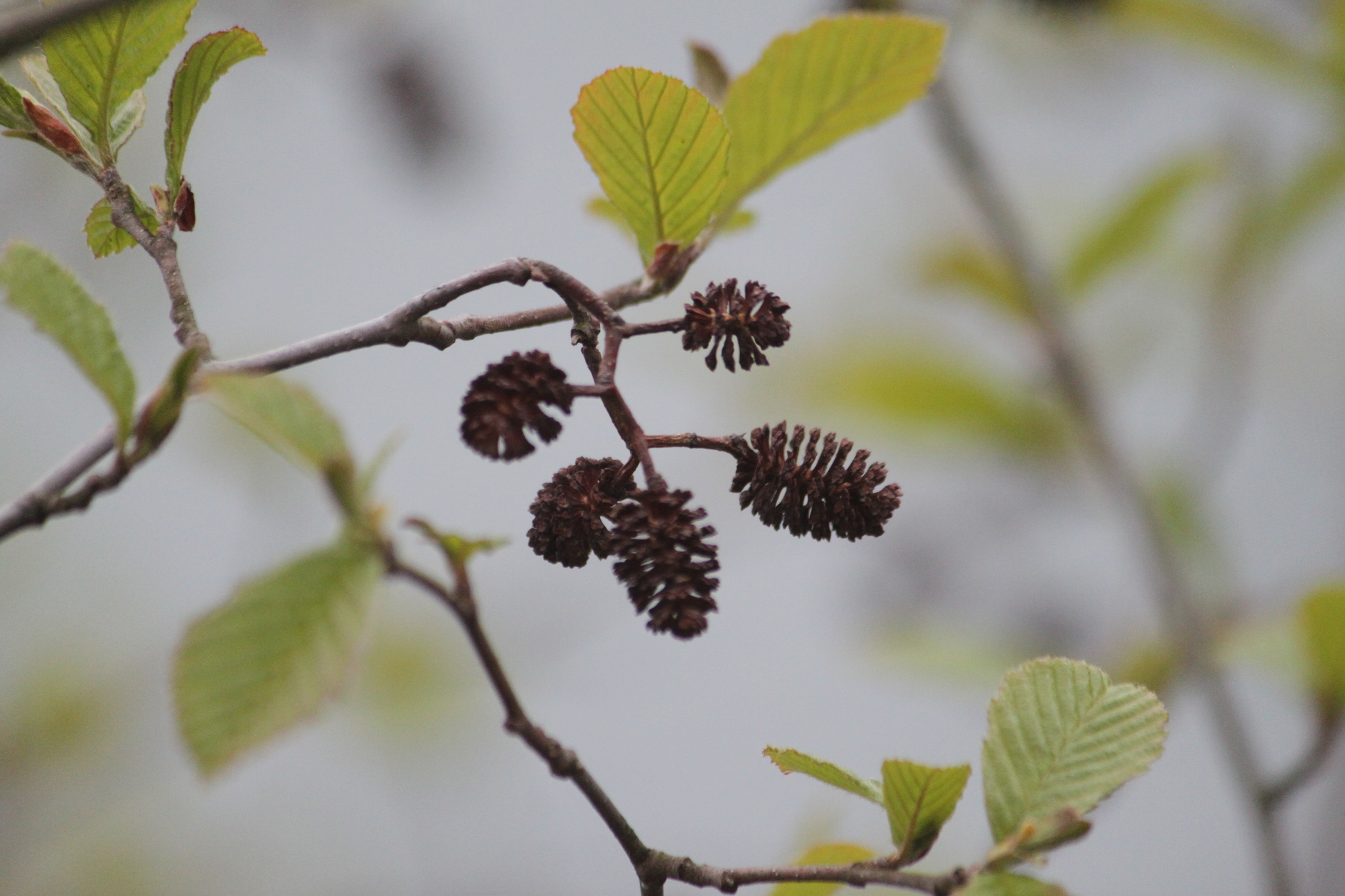
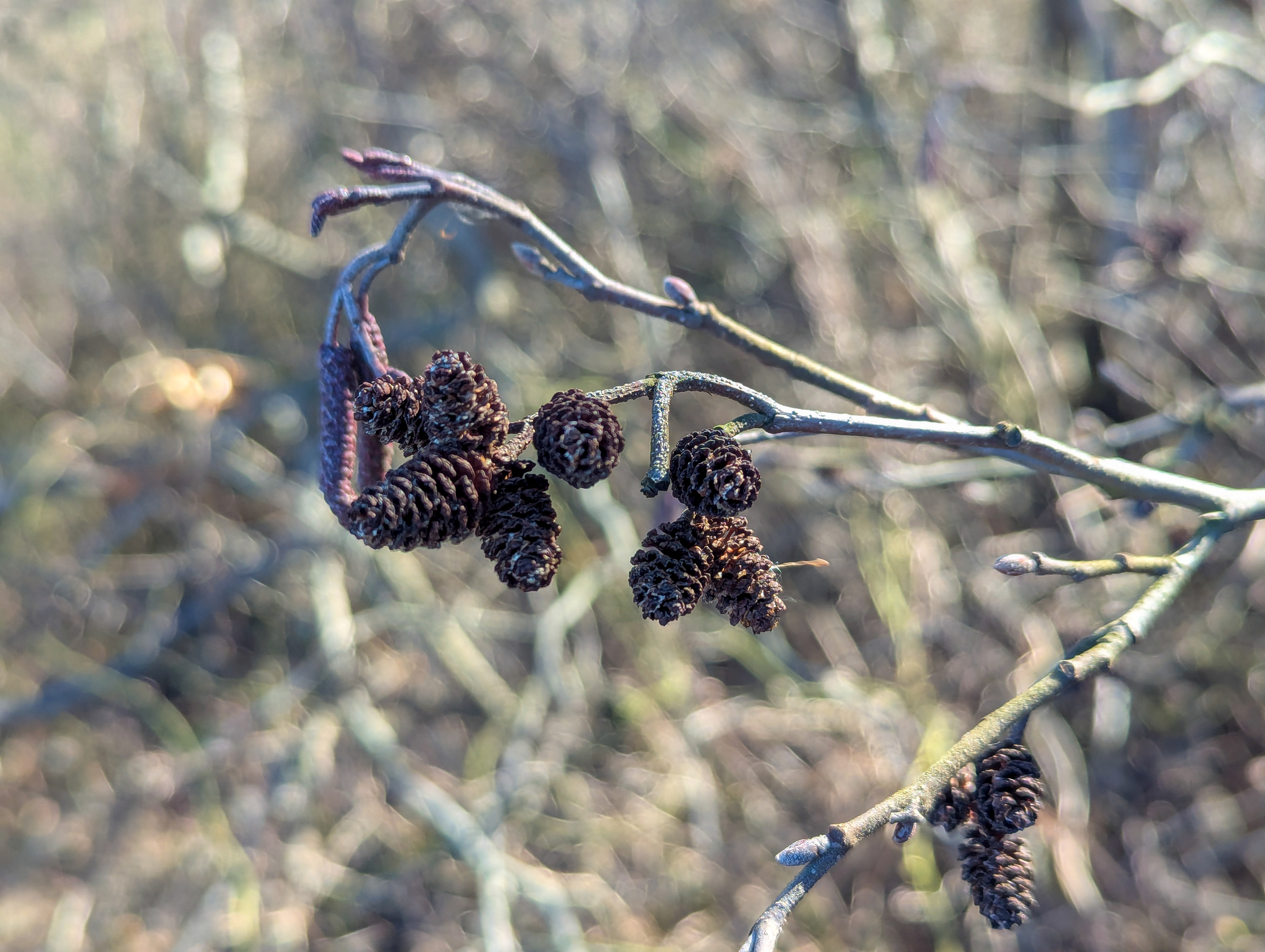
Fruit: The ovate, dark brown, cone-like fruit is hard with winged scales. Seeds are produced in small cones and do not have wings. Fruit usually matures during fall and is quite persistent.[citation needed]
Twig: The twigs are reddish-brown and have a three-angled-pith;[8] young twigs are covered with hairs.
Bark: The bark is brownish gray, smooth, and has a bitter and astringent taste.[citation needed]
-
 Leaves
 -
 Seed cones
 -
 Seeds
Seeds


Distribution
[edit]Alnus serrulata is mainly located in eastern North America. It ranges from Maine to Northern Florida, west to southeastern Oklahoma, Missouri, and Illinois. It also grows along the Mississippi River. It is not present in northern New Hampshire and Vermont. Smooth alder is classified as an facultative wetland species in the Atlantic and Gulf Coastal Plains and an obligate wetland species in the North and Midwest.[10]
Taxonomy
[edit]The scientific name of smooth alder is Alnus serrulata (Aiton) Willd., synonymous with Alnus noveboracensis Britton, Alnus rubra Desfontaines ex Spach,[citation needed] Alnus rugosa (Du Roi) Sprengel, Alnus rugosa (Du Roi) Sprengel var. serrulata (W. Aiton) H. Winkler, Alnus serrulata (W. Aiton) Willdenow var. subelliptica Fernald, and Betula serrulata W. Aiton. It has English common names including common alder, tag alder, hazel alder, brookside alder and smooth alder.[1]
Cultivation
[edit]Alnus serrulata can be found in habitats such as streambanks, riversides, and swamps. Water use is high and it requires sun or part-sun. It also requires moist soil that has a pH of 6.8–7.2.[citation needed] Alnus serrulata needs 5–10-foot spacing in wildlife habitat.[4]
Uses
[edit]Because the plant resides in riversides or stream streambanks, it usually functions as a stabilizer and restorer for those habitats. It is also used to treat astringent, diuretic, emetic, ophthalmic, and purgative symptoms. A tea made from the bark was used by Native Americans as a treatment for diarrhea, coughs, toothaches, sore mouth, and the pain of birth.[7][better source needed] It has also been used as a treatment for acne in the form of a skin wash.[9] An extract from the bark was used as an orange dye.[9]
Notes
[edit]- ^ a b Stritch, L. (2014). "Alnus serrulata". The IUCN Red List of Threatened Species. 208. IUCN. e.T194664A2356660. doi:10.2305/IUCN.UK.2014-3.RLTS.T194664A2356660.en.
- ^ "Alnus serrulata (Aiton) Willd". Integrated Taxonomic Information System. Retrieved 15 December 2025.
- ^ Wunderlin, R.P.; Hansen, B.F.; Franck, A.R.; Essig, F.B. (2025). "Alnus serrulata". Atlas of Florida Plants. Application development by S.M. Landry, K.N. Campbell and the USF Water Institute. Tampa: Institute for Systematic Botany, University of South Florida. Retrieved 15 December 2025.
- ^ a b c NRCS 2006.
- ^ USDA 2025, Characteristics section.
- ^ Tatnall 1946.
- ^ a b Tenaglia 2007.
- ^ a b Seiler et al. 2025.
- ^ a b c Seton 1912.
- ^ USDA 2025.
References
[edit]"Plant Fact Sheet: Smooth Alder" (PDF). U.S. Department of Agriculture Natural Resources Conservation Service. 30 May 2006. Archived from the original (PDF) on 24 October 2020.
"Plants Profile for Alnus serrulata (hazel alder)". plants.usda.gov. Retrieved 15 December 2025.
Seiler, John R.; Jensen, Edward C.; Niemiera, Alex; Peterson, John A. (2025). "Alnus serrulata Fact Sheet". VT Forest Biology and Dendrology. Virginia Tech Department of Forest Resources and Environmental Conservation. Retrieved 15 December 2025.
Seton, Ernest Thompson (1912). "Betulaceae". The Forester's Manual; Or, The Forest Trees of Eastern North America. Scout Manual Series. Vol. 2. Garden City, New York: Doubleday, Page & Company. pp. 57–58. OCLC 2643747.
Tatnall, Robert Richardson (1946). Flora of Delaware and the Eastern Shore; an Annotated List of the Ferns and Flowering Plants of the Peninsula of Delaware, Maryland and Virginia. Wilmington: Society of Natural History of Delaware. p. 99. OCLC 1045605448.
Tenaglia, Dan (8 February 2007). "Alnus serrulata (Ait.) Willd. - Tag Alder". Missouri Flora Web Page, Missouriplants. Archived from the original on 12 February 2018.
1. Fergus, Charles, and Amelia Hansen. Trees of New England: a Natural History. Guilford, CT: FalconGuide, 2005. 4. Print.
2. Seton, Ernest Thompson. The Book of Woodcraft. Garden City, NY: Garden City Pub., 1921. 383. Print.
External links
[edit] Media related to Alnus serrulata at Wikimedia Commons
 Data related to Alnus serrulata at Wikispecies

