White Thoroughwort
Eupatorium album Linnaeus
White Thoroughwort: https://www.marylandbiodiversity.org/species/4269
Synonyms
Eupatorium petaloideum (misapplied)
Tags

Map Snapshot

58 Records

Status

White Thoroughwort should be compared with Eupatorium vaseyi. Historic records of Eupatorium album, E. fernaldii (not yet reported from Maryland) and E. vaseyi may be conflated.

Description

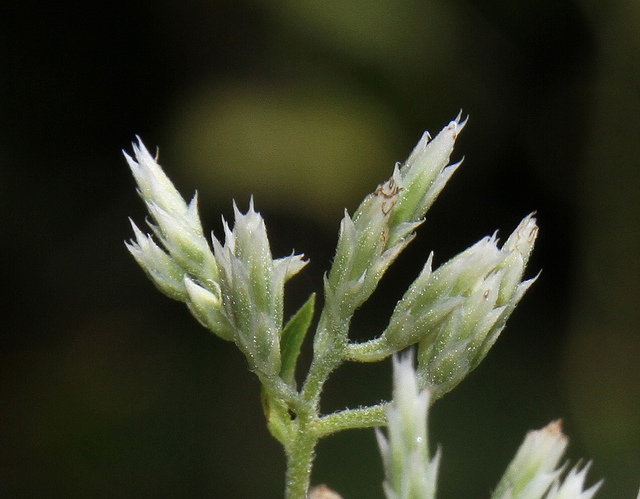
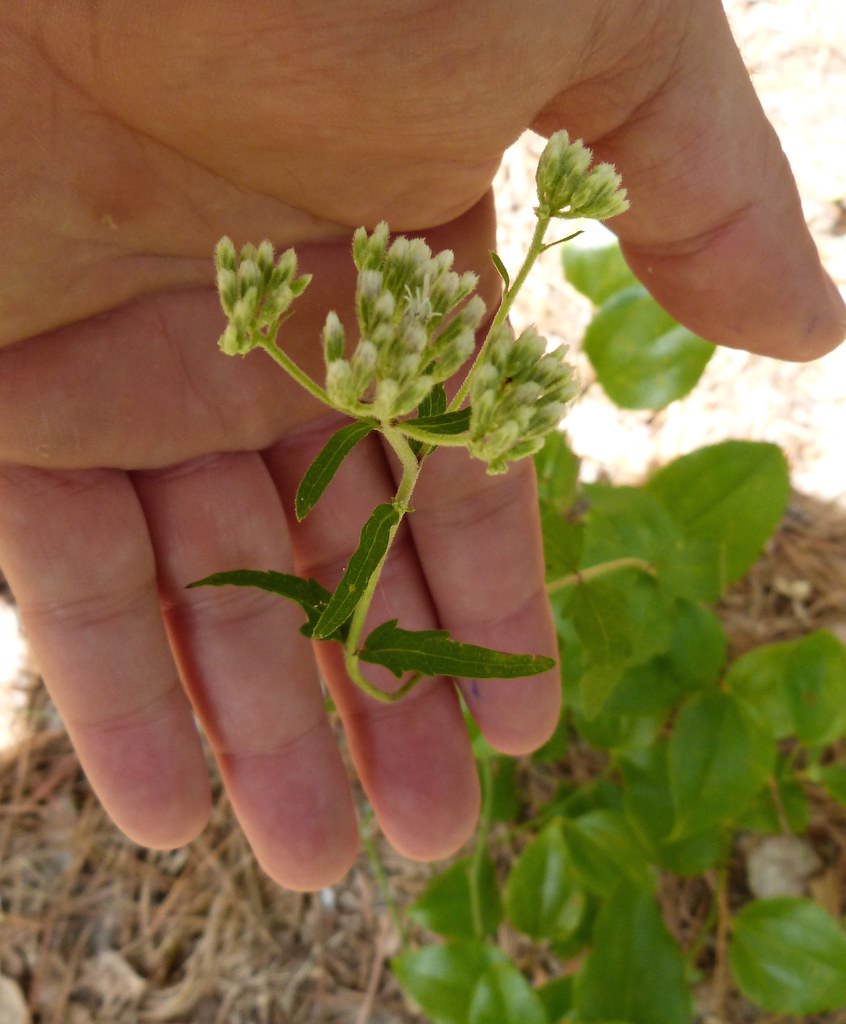
White Thoroughwort has sessile, simple, lanceolate leaves and long-attenuate inner phyllaries. The leaves of White Thoroughwort are generally more than 6 cm long and 1.5 cm wide. It can be distinguished from similar-looking species by the shape and width of the leaf, the distribution of hairs on the stem, and the presence of resin glands on the leaves and phyllaries.

See Eupatorium vaseyi for comparison of the most-similar species.

Relationships

Host plant for the Bonset Borer Moth.

Citations

No citations linked for this taxon yet.

Use of media featured on Maryland Biodiversity Project is only permitted with express permission of the photographer.

Source: Wikipedia

Eupatorium album
Secure
Secure (NatureServe)[1]
Scientific classification Edit this classification
Kingdom: Plantae
Clade: Tracheophytes
Clade: Angiosperms
Clade: Eudicots
Clade: Asterids
Order: Asterales
Family: Asteraceae
Genus: Eupatorium
Species:
E. album
Binomial name
Eupatorium album
Synonyms[2]
Synonymy
  • Uncasia alba (L.) Greene
  • Eupatorium fernaldii R.K.Godfrey
  • Eupatorium glandulosum Michaux
  • Eupatorium petalodium Britton ex Small
  • Eupatorium petaloideum Britton ex Britton
  • Eupatorium stigmatosum Bertol. 1846 not Meyen & Walp. 1843 nor Chodat 1843
  • Uncasia petaloidea (Britton ex Small) Greene

Eupatorium album, the white thoroughwort or snowy white eupatorium, is a herbaceous perennial plant in the family Asteraceae native from the eastern and southern United States, from eastern Texas to Connecticut, inland as far as Indiana.[3][4]

As with other members of the genus Eupatorium, Eupatorium album flowers with large numbers of small white heads. The flower heads have 4-5 disc florets each, but no ray florets.[5] It flowers from late June to October.[6] The plant grows 50–100 cm (20–39 in) tall,[3] making it one of the shorter Eupatorium species.[5]

Eupatorium album is capable of hybridizing with other Eupatorium species including Eupatorium sessilifolium and Eupatorium serotinum.[3] Its appearance is similar to Eupatorium altissimum, but differs in that the bracts (located at the base of the flower head) taper to a long point.[7]

Eupatorium album grows in dry, open areas such as power lines, old fields, and eroded slopes. It will not grow under a shady canopy, but can be found in some open woods such as pine barrens.[7] It is common in fire-dependent habitats, and increases in abundance in response to fire disturbance.[8]

Varieties[3]

References

[edit]
  1. ^ "Eupatorium album". NatureServe Explorer. NatureServe. Retrieved 2010-09-12.{{cite web}}: CS1 maint: deprecated archival service (link)
  2. ^ The Plant List, Eupatorium album L.
  3. ^ a b c d "Eupatorium album". Flora of North America.
  4. ^ Biota of North America Program 2014 county distribution map
  5. ^ a b "Eupatorium". Flora of North America.
  6. ^ "Eupatorium album (White-bracted Thoroughwort) - FSUS". fsus.ncbg.unc.edu. Retrieved 2025-08-26.
  7. ^ a b Rebecca W. Dolan (September 2004). "Conservation Assessment for White thoroughwort (Eupatorium album L.)" (PDF). United States Forest Service, Eastern Region of the Forest Service - Threatened and Endangered Species Program.
  8. ^ Moore, William H.; Swindel, Benee F.; Terry, W. Stephen (1982). "Vegetative Response to Prescribed Fire in a North Florida Flatwoods Forest". Journal of Range Management. 35 (3): 386. doi:10.2307/3898325. ISSN 0022-409X. JSTOR 3898325.

Further reading

[edit]
[edit]