
Map Snapshot


5 Records
Status
Description
Citations
No citations linked for this taxon yet.
Source: Wikipedia
| Cortinarius armillatus | |
|---|---|

| |

| |
Scientific classification 
| |
| Kingdom: | Fungi |
| Division: | Basidiomycota |
| Class: | Agaricomycetes |
| Order: | Agaricales |
| Family: | Cortinariaceae |
| Genus: | Cortinarius |
| Species: | C. armillatus
|
| Binomial name | |
| Cortinarius armillatus | |
| Cortinarius armillatus | |
|---|---|
| Mycological characteristics | |
 | Gills on hymenium |

 | Cap is campanulate or convex |

 | Hymenium is adnate or sinuate |
 | Stipe has a cortina |
 | Spore print is brown |
 | Ecology is mycorrhizal |
 | Edibility is not recommended |
Cortinarius armillatus, commonly known as the red-banded cort[1] or bracelet cortinarius,[2] is a species of fungus found in North America. Sometimes reported as edible, it may resemble poisonous species and itself contains a mycotoxin.
Taxonomy
[edit]Elias Magnus Fries described the species in 1838.[3]
Description
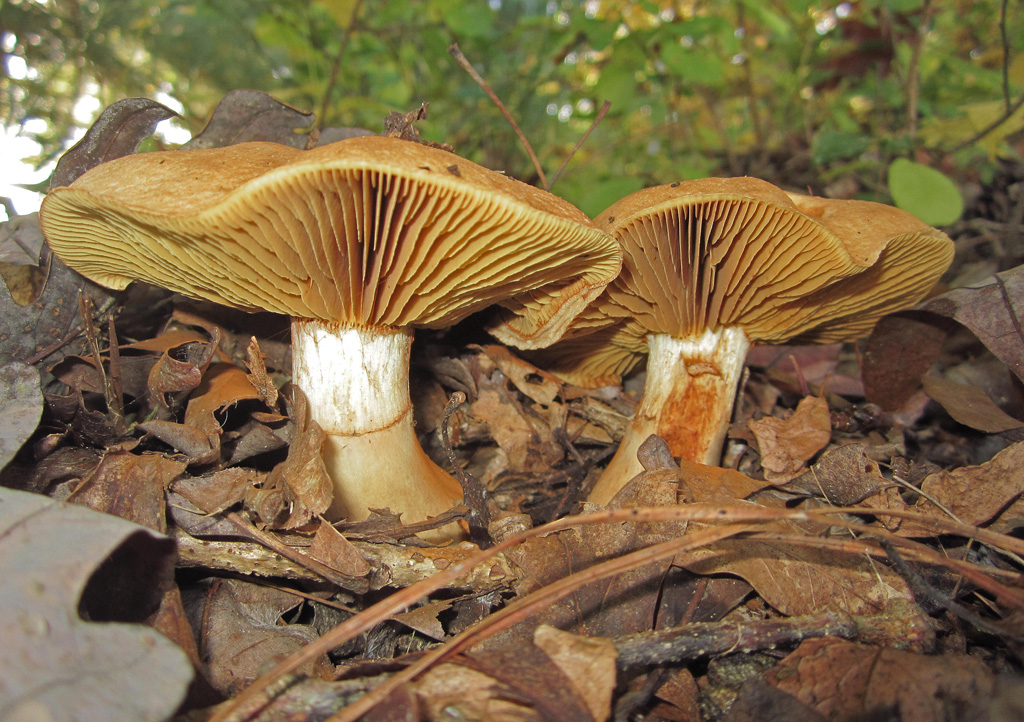
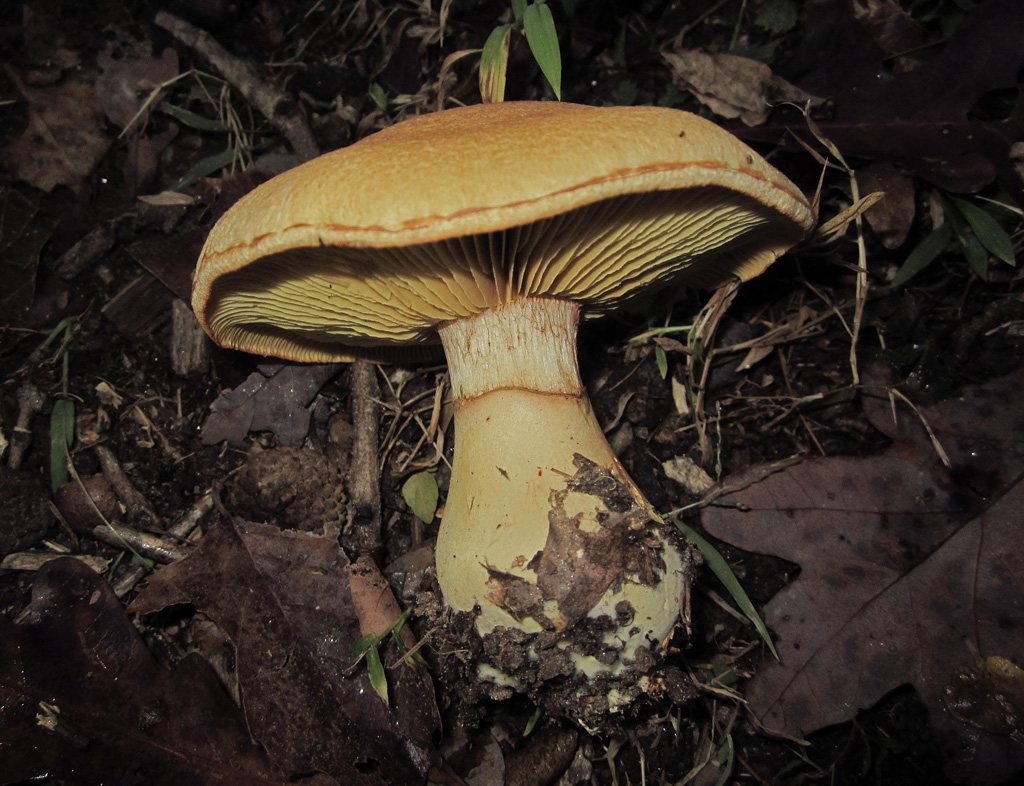
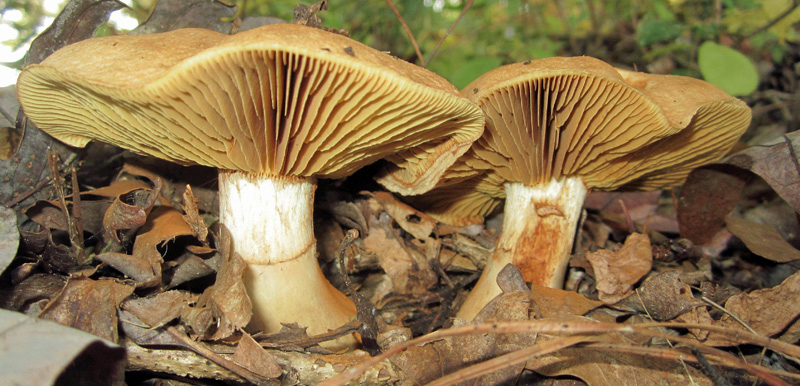
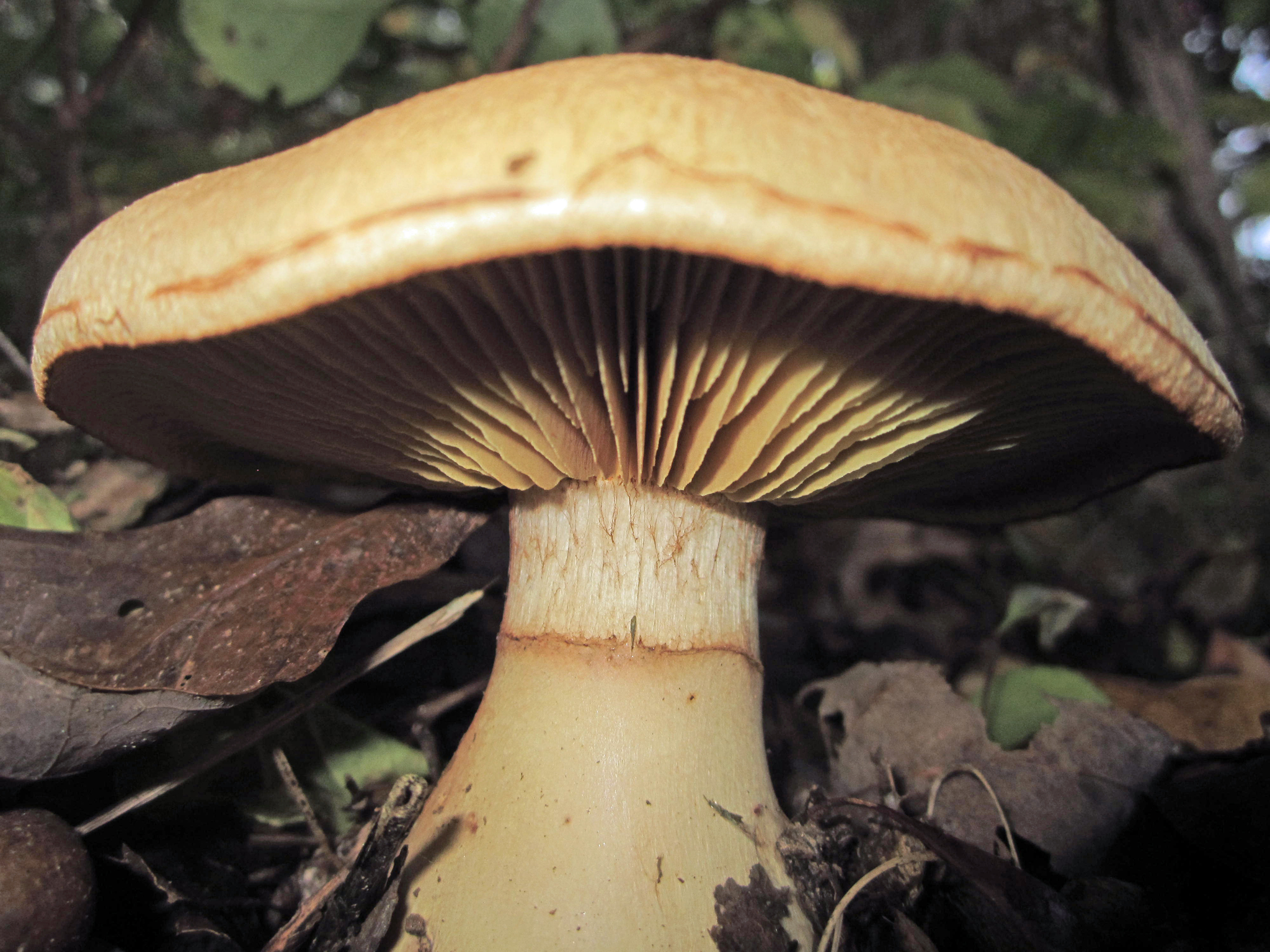
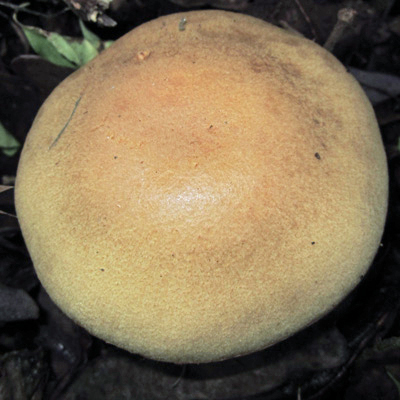
[edit]The cap is 4 to 13 centimetres (1+1⁄2 to 5 in) wide, orangish-brown, bun to bell-shaped then flattening out, and sometimes developing small scales.[2] The gills are tan when young, then rusty brown. They are somewhat close,[1] and shallowly sinuate. The spore print is rusty brown.[1]
The tannish stem is up to 15 cm (6 in) long and 2.5 cm (1 in) thick;[1][2] it is usually wider at the base and has 1–5 reddish bands.[1] The flesh is light brown[2] and its scent mild to radish-like.[1]
Similar species
[edit]It resembles C. bolaris,[1] C. boulderensis, C. haematochelis,[2] C. paragaudis, C. rubicundulus,[1] and C. subtestaceus.[2] Some species in the genus contain the mycotoxin orellanine, which can be deadly.[4]
Habitat and distribution
[edit]It can be found from August to September under birch trees in North America[1] (especially the northeast)[2] and in Europe.
Uses
[edit]The species has been considered edible and mediocre[5] to good, with caution advised to confirm its identification.[2] Some guides consider it inedible,[6] and it has been found to contain orellanine, though at much lower concentrations than the lethal webcaps.[4]
When dyeing cloths, without added metals, it discharges pink, with tin yellow, with copper green and with iron olivic dyes.
References
[edit]- ^ a b c d e f g h i Audubon (2023). Mushrooms of North America. Knopf. p. 634. ISBN 978-0-593-31998-7.
- ^ a b c d e f g h Arora, David (1986) [1979]. Mushrooms Demystified: A Comprehensive Guide to the Fleshy Fungi (2nd ed.). Berkeley, CA: Ten Speed Press. pp. 448–449. ISBN 978-0-89815-170-1.
- ^ Cortinarius armillatus in MycoBank.
- ^ a b Shao D, Tang S, Healy RA, Imerman PM, Schrunk DE, Rumbeiha WK (2016). "A novel orellanine containing mushroom Cortinarius armillatus". Toxicon. 114: 65–74. Bibcode:2016Txcn..114...65S. doi:10.1016/j.toxicon.2016.02.010. PMID 26915341.
- ^ Miller Jr., Orson K.; Miller, Hope H. (2006). North American Mushrooms: A Field Guide to Edible and Inedible Fungi. Guilford, CN: FalconGuide. p. 313. ISBN 978-0-7627-3109-1.
- ^ Phillips, Roger (2010). Mushrooms and Other Fungi of North America. Buffalo, NY: Firefly Books. p. 180. ISBN 978-1-55407-651-2.
External links
[edit] Media related to Cortinarius armillatus at Wikimedia Commons
- Cortinarius armillatus in Index Fungorum.

 | This Cortinariaceae-related article is a stub. You can help Wikipedia by adding missing information. |