
Map Snapshot


28 Records
Status
Description
Citations
No citations linked for this taxon yet.
Source: Wikipedia
| Cortinarius alboviolaceus | |
|---|---|

| |
Scientific classification 
| |
| Kingdom: | Fungi |
| Division: | Basidiomycota |
| Class: | Agaricomycetes |
| Order: | Agaricales |
| Family: | Cortinariaceae |
| Genus: | Cortinarius |
| Species: | C. alboviolaceus
|
| Binomial name | |
| Cortinarius alboviolaceus | |
| Synonyms[1] | |
|
Agaricus glaucopus Pers. (1801) | |
Cortinarius alboviolaceus, commonly known as the silvery-violet webcap,[2] is a basidiomycete mushroom of the genus Cortinarius native to Europe and North America.
Description
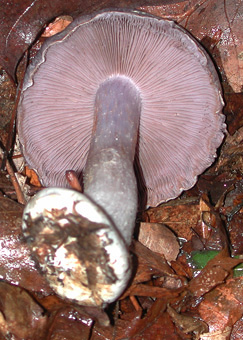
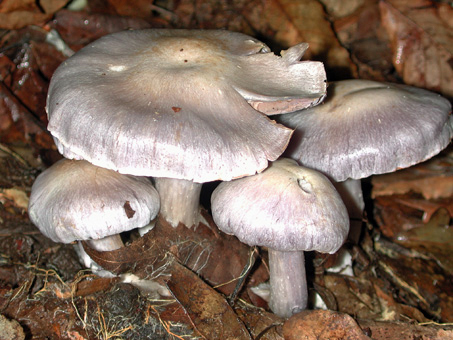
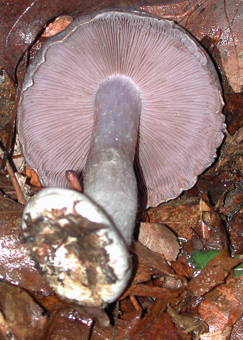
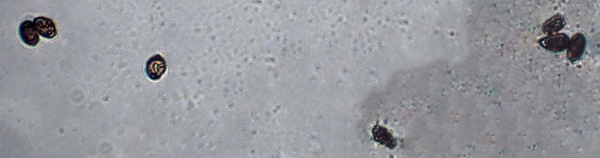
[edit]The mushroom is lilac, later yellowing and often becoming whitish/grayish.[3][4] Its cap is 3–8 cm wide, conical to umbonate, dry, silky, with whitish to pale lilac flesh.[3][4] The gills are adnate or adnexed, grayish lilac becoming brown as the spores mature and lend their color.[3] The stalk is 4–8 cm tall and .5–1.5 wide, larger at the base, sometimes with white veil tissue.[3][4] The odour and taste are indistinct.[4]
Similar species
[edit]Similar species include the essentially identical C. griseoviolaceus, as well as Inocybe lilacina.[3] C. camphoratus is similar, but with a foul odour. C. malachius has a grayish cap and, when dry, a scaly surface.[4]
Potential edibility
[edit]Its edibility is considered unknown by some guides but it is not recommended due to its similarity to deadly poisonous species.[3] At least one guide considers it edible, but not recommended.[5] Conflicting accounts indicate that it may itself be poisonous.[6]
References
[edit]| Cortinarius alboviolaceus | |
|---|---|
| Mycological characteristics | |
 | Gills on hymenium |

 | Cap is conical or umbonate |

 | Hymenium is adnexed or adnate |
 | Stipe has a cortina |
 | Spore print is brown |
 | Ecology is mycorrhizal |
 | Edibility is unknown |
- ^ "Cortinarius alboviolaceus (Pers.) Fr". Index Fungorum. CAB International. Retrieved 9 September 2015.
- ^ Siegel, Noah; Schwarz, Christian (September 1, 2024). Mushrooms of Cascadia: A Comprehensive Guide to Fungi of the Pacific Northwest. Humboldt County, CA: Backcountry Press. p. 193. ISBN 9781941624197.
- ^ a b c d e f Davis, R. Michael; Sommer, Robert; Menge, John A. (2012). Field Guide to Mushrooms of Western North America. Berkeley: University of California Press. pp. 258–259. ISBN 978-0-520-95360-4. OCLC 797915861.
- ^ a b c d e Trudell, Steve; Ammirati, Joe (2009). Mushrooms of the Pacific Northwest. Timber Press Field Guides. Portland, OR: Timber Press. pp. 149–150. ISBN 978-0-88192-935-5.
- ^ Phillips, Roger (2010). Mushrooms and Other Fungi of North America. Buffalo, NY: Firefly Books. p. 177. ISBN 978-1-55407-651-2.
- ^ Miller Jr., Orson K.; Miller, Hope H. (2006). North American Mushrooms: A Field Guide to Edible and Inedible Fungi. Guilford, CN: FalconGuide. p. 315. ISBN 978-0-7627-3109-1.
 | This Cortinariaceae-related article is a stub. You can help Wikipedia by adding missing information. |