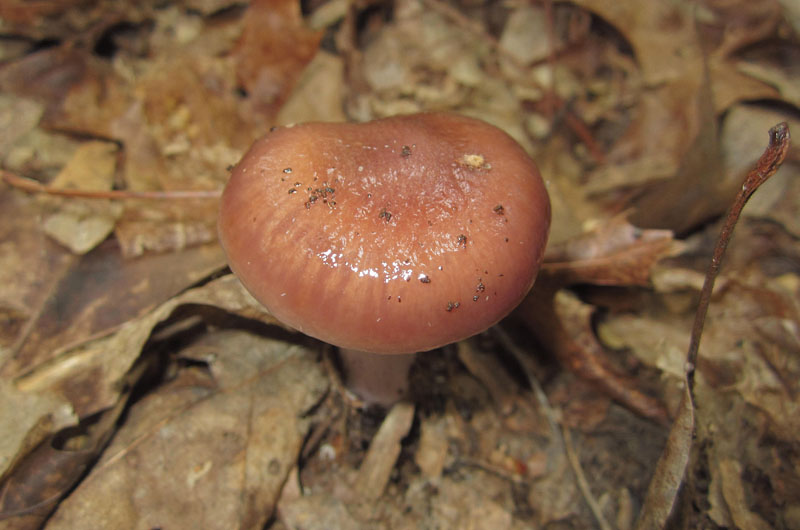
A Slimy-banded Cort (young fruiting body) in Howard Co., Maryland (8/11/2017).
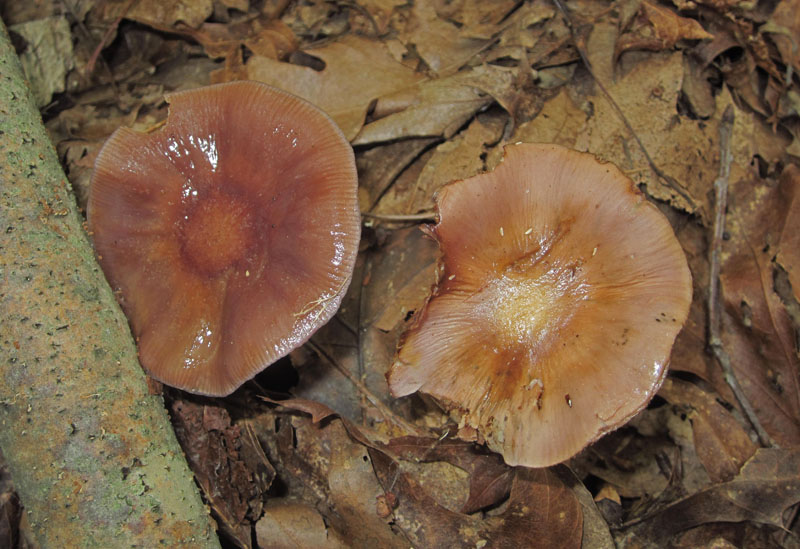
Slimy-banded Cort (mature caps) in Howard Co., Maryland (8/11/2017).
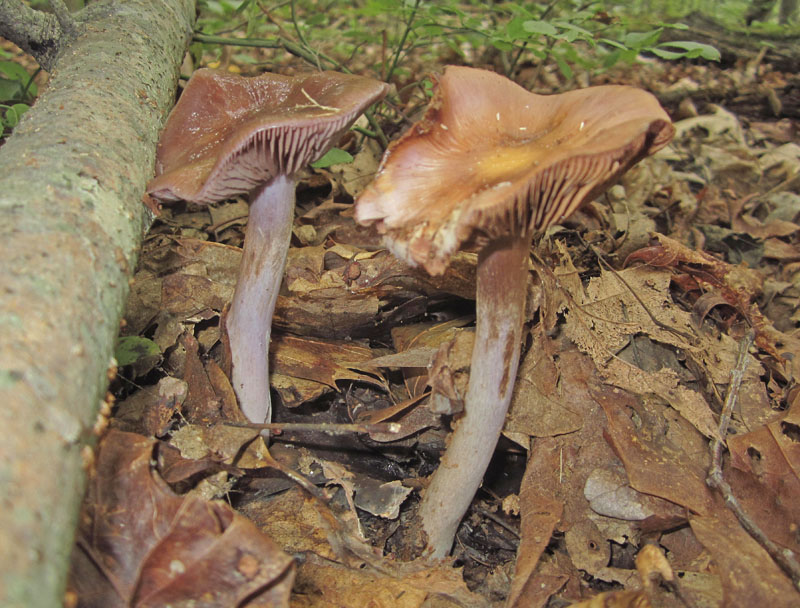
Slimy-banded Cort (mature fruiting bodies with rusty ring zone on stalks) in Howard Co., Maryland (8/11/2017).
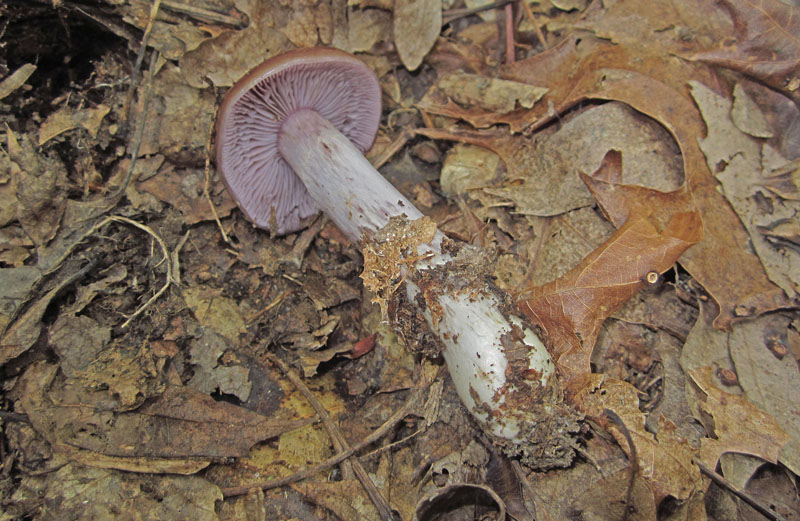
A Slimy-banded Cort (gills and stalk) in Howard Co., Maryland (8/11/2017).
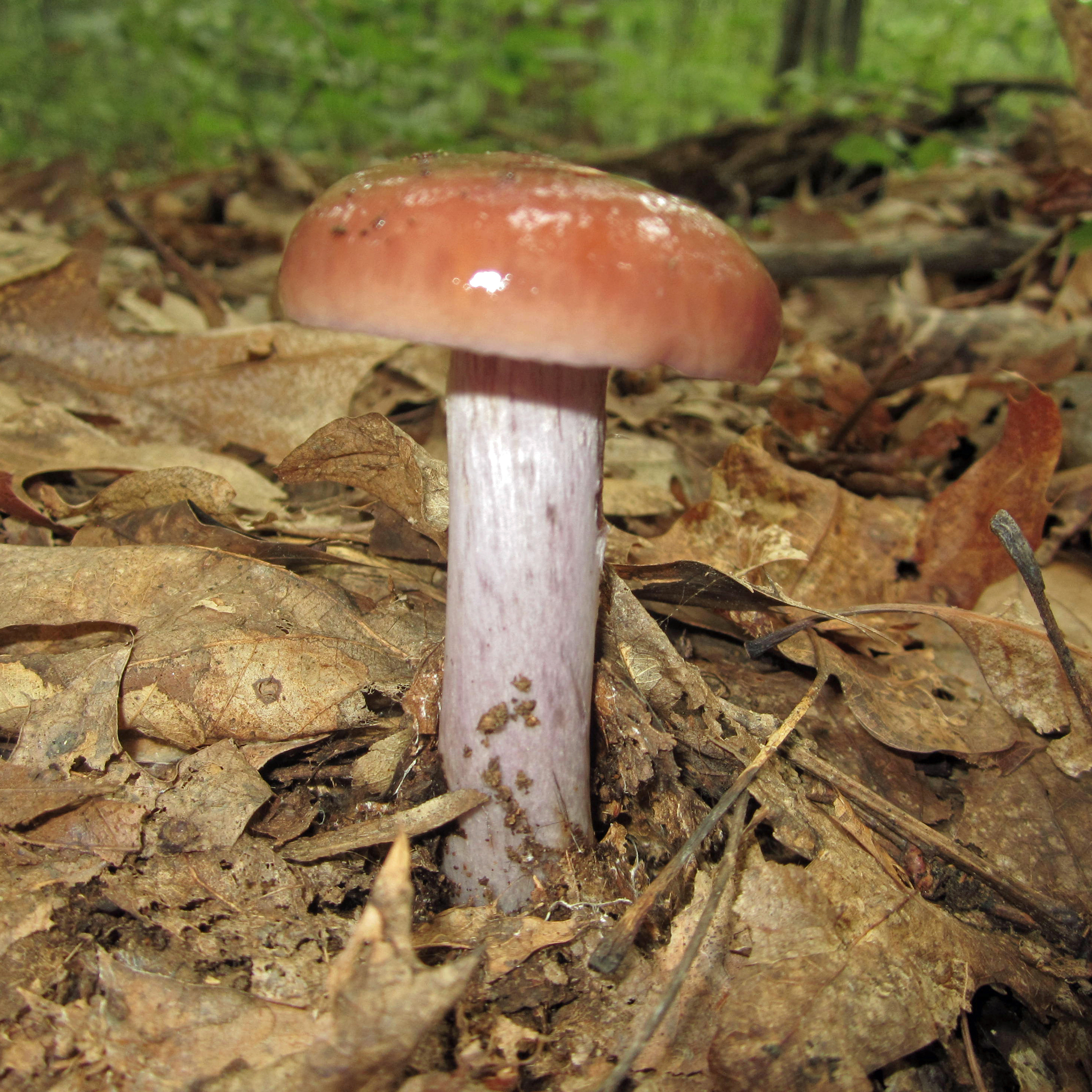
Slimy-banded Cort in Howard Co., Maryland (8/11/2017). (c) Joanne and Robert Solem, some rights reserved (CC BY-NC).
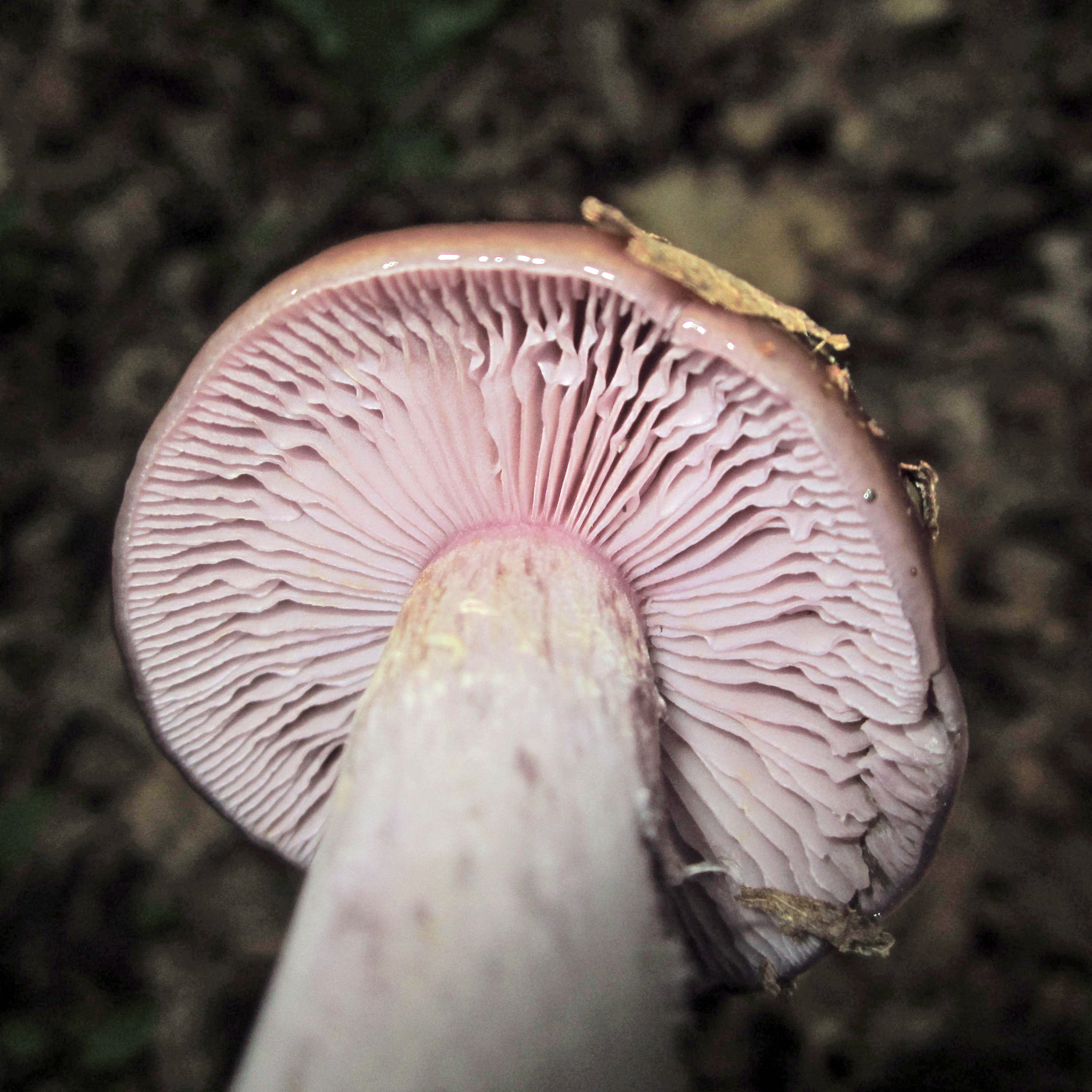
Slimy-banded Cort in Howard Co., Maryland (8/11/2017). (c) Joanne and Robert Solem, some rights reserved (CC BY-NC).
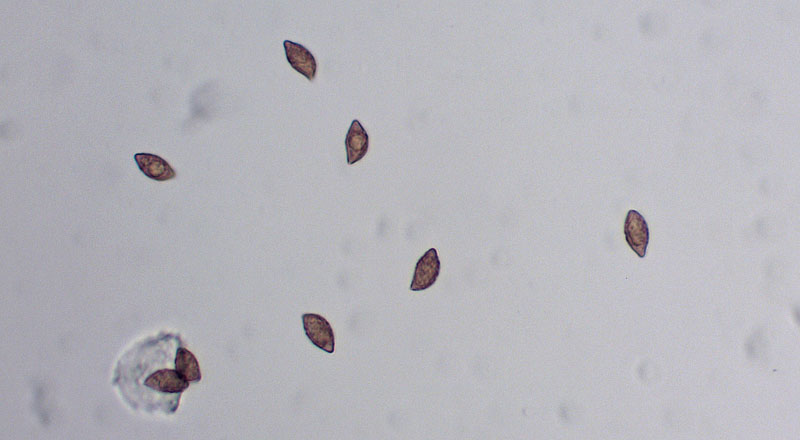
Slimy-banded Cort spores collected in Howard Co., Maryland (8/11/2017). football-shaped, finely warty; measured 13.2-15.6 X 6.6-8.0 miccrons.
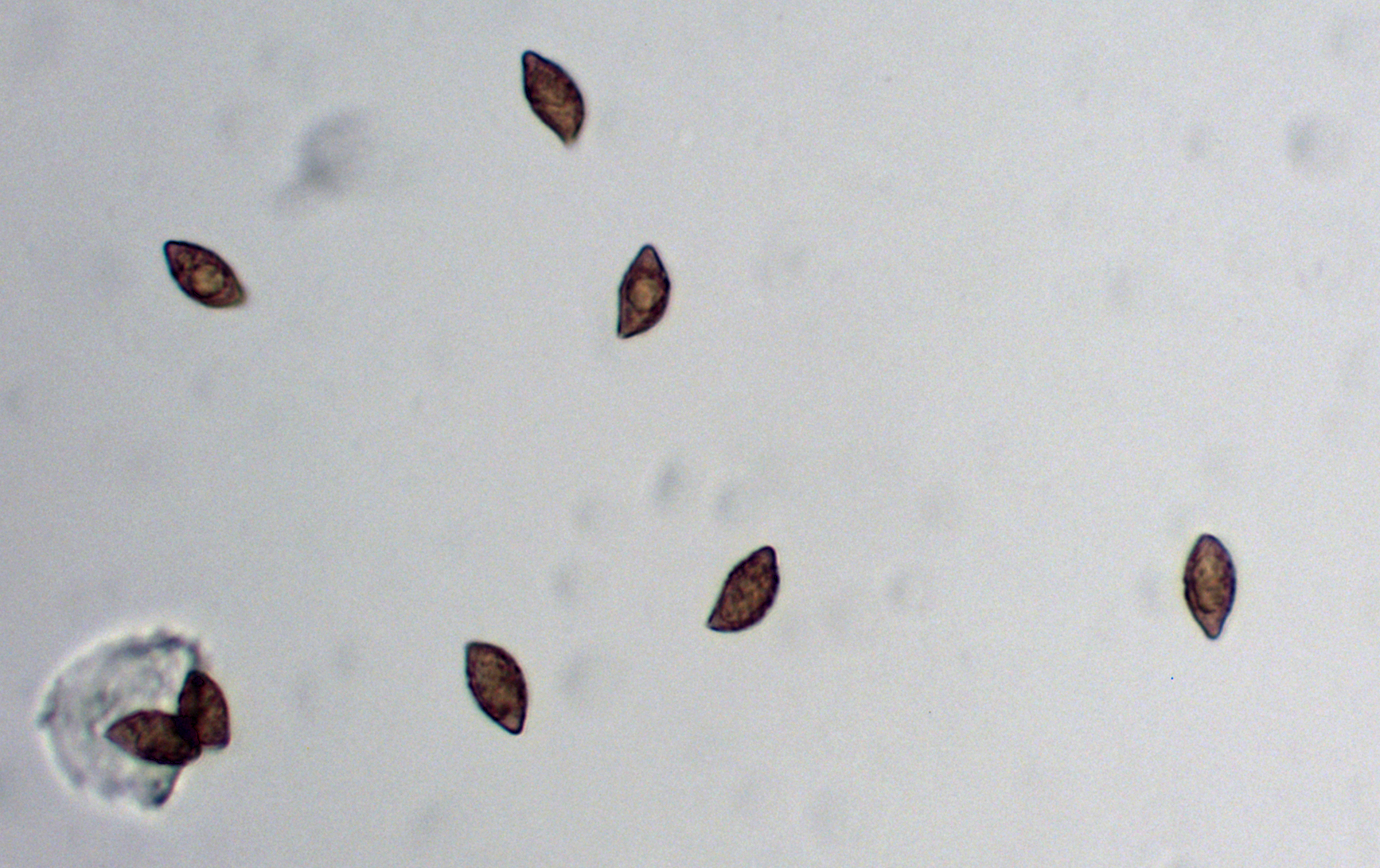
Spores collected from a Slimy-banded Cort specimen in Howard Co., Maryland (8/11/2017). (c) Joanne and Robert Solem, some rights reserved (CC BY-NC).
Map Snapshot


3 Records
Description
Cap: Variable from purplish-brown to orange or yellow-brown in age; slimy; convex to flat with depressed center in age; finely-lined margin; whitish/purplish flesh. Gills: Lilac/pale purple to rusty-brown, may have whitish edges; close. Stalk: White to same as cap; dry; rusty ring zone may be present; slime may remain as purplish patches (J. Solem, pers. comm.).
Where To Find
Scattered, groups on ground in coniferous and hardwood forests (J. Solem, pers. comm.).
Citations
No citations linked for this taxon yet.
Eating mushrooms can be dangerous. One should do so only with expert advice and great care. MBP accepts no liability for injury sustained in consuming fungi or other biodiversity. Use of media featured on Maryland
Biodiversity Project is only permitted with express permission of the
photographer.
A Slimy-banded Cort (young fruiting body) in Howard Co., Maryland (8/11/2017).
View Record Details
Media by
Joanne Solem.
Slimy-banded Cort (mature caps) in Howard Co., Maryland (8/11/2017).
View Record Details
Media by
Joanne Solem.
Slimy-banded Cort (mature fruiting bodies with rusty ring zone on stalks) in Howard Co., Maryland (8/11/2017).
View Record Details
Media by
Joanne Solem.
A Slimy-banded Cort (gills and stalk) in Howard Co., Maryland (8/11/2017).
View Record Details
Media by
Joanne Solem.
Slimy-banded Cort in Howard Co., Maryland (8/11/2017). (c) Joanne and Robert Solem, some rights reserved (CC BY-NC).
View Record Details
Media by
Joanne Solem.
Slimy-banded Cort in Howard Co., Maryland (8/11/2017). (c) Joanne and Robert Solem, some rights reserved (CC BY-NC).
View Record Details
Media by
Joanne Solem.
Slimy-banded Cort spores collected in Howard Co., Maryland (8/11/2017). football-shaped, finely warty; measured 13.2-15.6 X 6.6-8.0 miccrons.
View Record Details
Media by
Robert Solem.
Spores collected from a Slimy-banded Cort specimen in Howard Co., Maryland (8/11/2017). (c) Joanne and Robert Solem, some rights reserved (CC BY-NC).
View Record Details
Media by
Joanne Solem.
Source: Wikipedia
| Cortinarius collinitus | |
|---|---|

| |
Scientific classification 
| |
| Kingdom: | Fungi |
| Division: | Basidiomycota |
| Class: | Agaricomycetes |
| Order: | Agaricales |
| Family: | Cortinariaceae |
| Genus: | Cortinarius |
| Species: | C. collinitus
|
| Binomial name | |
| Cortinarius collinitus | |
| Cortinarius collinitus | |
|---|---|
| Mycological characteristics | |
 | Gills on hymenium |

 | Cap is convex or flat |
 | Hymenium is adnexed |
 | Stipe has a cortina |
 | Spore print is reddish-brown |
 | Ecology is mycorrhizal |
 | Edibility is inedible |
Cortinarius collinitus, commonly known as the belted slimy cortinarius,[1] is a species of fungus in the family Cortinariaceae.
Description
[edit]The cap is 3–10 centimetres (1+1⁄4–4 in) in diameter,[1] convex to flat in shape, with a sticky, gelatinous surface (in moist conditions). The gills are adnexed, close, and pallid or pale violet in color. The stipe is typically 5–15 cm long, 0.5–2 cm thick, solid and equal.[1] It has transverse scaly-looking bands. The spore print is rusty-brown,[1] like that of most Cortiniarius species.
The species is considered inedible,[2] partly due to the complex of related species not yet having been tested.[1]
Habitat and distribution
[edit]It grows singly or in groups with hardwoods and conifers.[1]
See also
[edit]References
[edit]- ^ a b c d e f Arora, David (1986) [1979]. Mushrooms Demystified: A Comprehensive Guide to the Fleshy Fungi (2nd ed.). Berkeley, CA: Ten Speed Press. pp. 431–32. ISBN 978-0-89815-170-1.
- ^ Phillips, Roger (2010). Mushrooms and Other Fungi of North America. Buffalo, NY: Firefly Books. p. 160. ISBN 978-1-55407-651-2.
External links
[edit]- Medicinal Mushrooms description and medicinal properties
- Roger's Mushrooms description