Map Snapshot


3 Records
Status
Relationships
Citations
No citations linked for this taxon yet.
Source: Wikipedia
| Neoerysiphe galeopsidis | |
|---|---|

| |
Scientific classification 
| |
| Kingdom: | Fungi |
| Division: | Ascomycota |
| Class: | Leotiomycetes |
| Order: | Helotiales |
| Family: | Erysiphaceae |
| Genus: | Neoerysiphe |
| Species: | N. galeopsidis
|
| Binomial name | |
| Neoerysiphe galeopsidis (DC.) U. Braun, 1999
| |
| Synonyms | |
| |
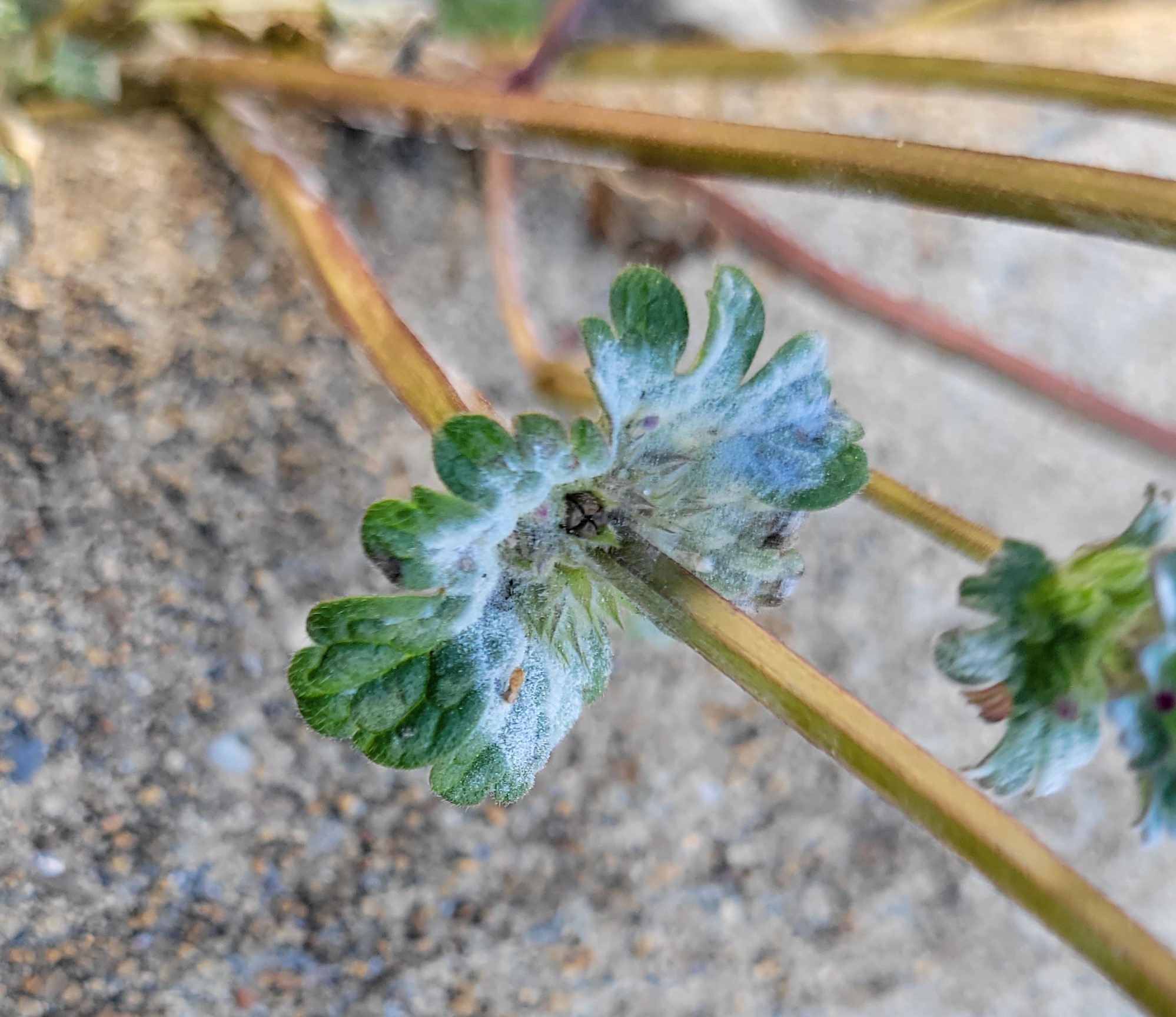
Neoerysiphe galeopsidis is a species complex of powdery mildews in the family Erysiphaceae. It is found across Eurasia and North America, and has also been introduced to Australia, where it affects a large variety of different hosts in multiple plant families including the Acanthaceae and Lamiaceae. It has been reported as an accidental infection on Catalpa. Neoerysiphe galeopsidis sensu stricto occurs on multiple genera including Galeopsis and Lamium.[1]
Description
[edit]The fungus forms dense, white fuzzy patches on the leaves of its host. Neoerysiphe galeopsidis sensu lato infects many genera, and may be split up in future. Infections on some plants, such as lamb's-ear, can be less easy to spot.
Taxonomy
[edit]The fungus was formally described in 1815 by De Candolle with the basionym Erysiphe galeopsidis. The species was transferred to the genus Neoerysiphe by Uwe Braun in 1999.[2] Bradshaw et al. (2022) recovered three clear clades within Neoerysiphe galeopsidis, with moderate to high support: a "true" clade on Lamium, Galeopsis, etc.; a European Stachys-infecting clade; and an American Stachys-infecting clade.[3]
References
[edit]- ^ Braun, Uwe; Cook, Roger T. A. (2012). Taxonomic manual of the Erysiphales (powdery mildews). CBS biodiversity series. Utrecht: CBS-KNAW fungal biodiversity centre. ISBN 978-90-70351-89-2.
- ^ Braun, Uwe (1999). "Some critical notes on the classification and the generic concept of the Erysiphaceae" (PDF). Schlechtendalia. 3: 50.
- ^ Bradshaw, Michael J.; Braun, Uwe; Götz, Monika; Pfister, Donald H. (2022-11-02). "Phylogeny and taxonomy of the genera of Erysiphaceae, part 2: Neoerysiphe". Mycologia. 114 (6): 994–1007. doi:10.1080/00275514.2022.2115420. ISSN 0027-5514.